
The Drawn Sea
The Plumb comes up into blinding noon on the bed of the southern sea, emptied by the Tide: a desert of salt, stranded ships, and a crusade marching on a city in the sky.
 Art in progress
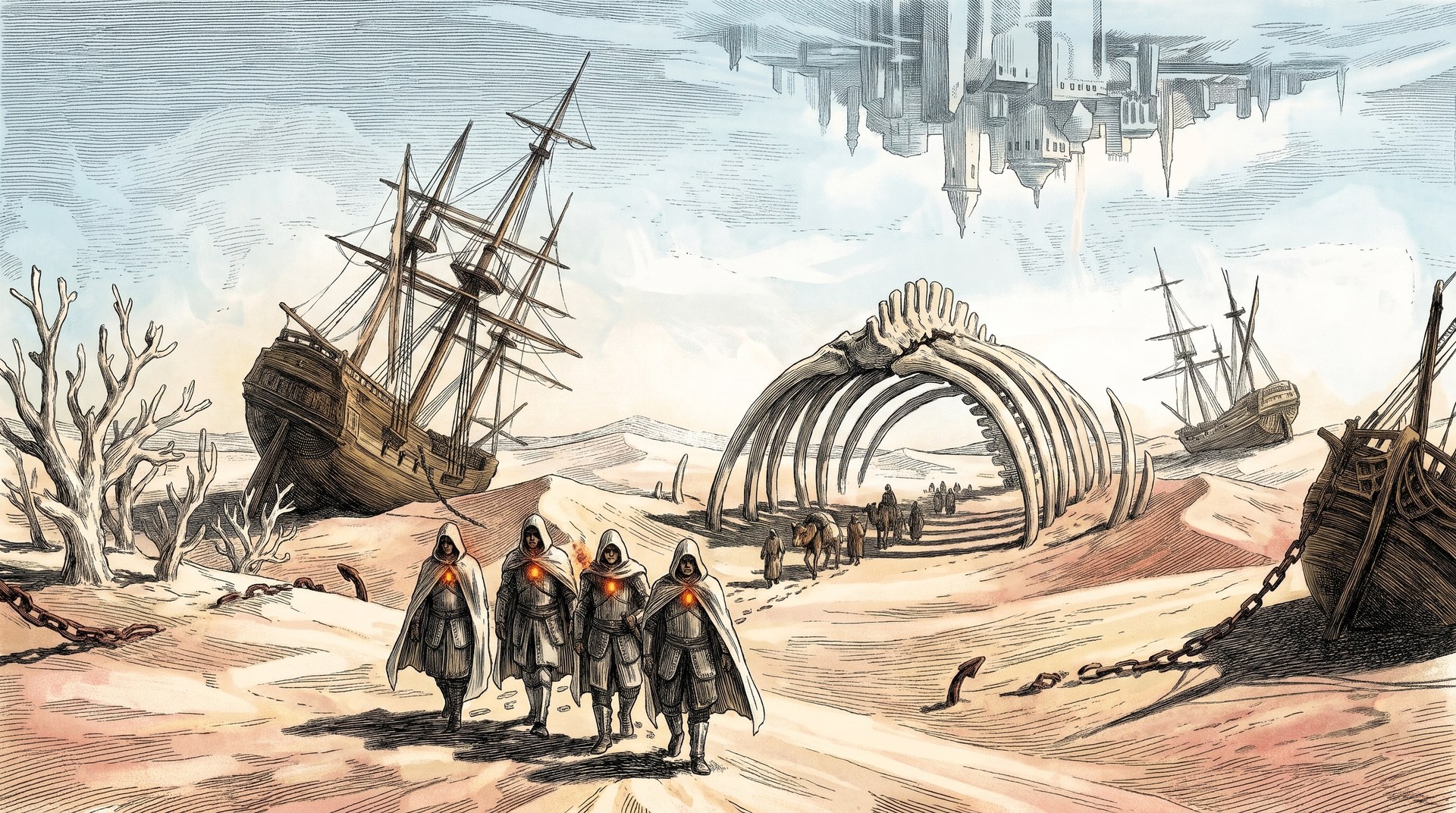
A ship sits upright on a dune with its sails still set, and the sand has drifted to its rail.
The Plumb's cage comes up at Lowmouth, the old mine-head at the edge of the seabed, and the first daylight of the climb is blinding. To drown a fire that deep, the Tide needed a whole sea. It drew the southern sea out of its bed and poured it into Saltreach; what it left behind is the Drawn Sea. This opens the second act, the Drowned World; which regions sit in which act is a proposal, from the overview.
What you find
Blinding white noon. Salt flats that run past the edge of sight, cracked into plates. Pale dunes. A turquoise sky with no cloud in it, and shadows so deep a blue they look wet. Heat comes up off the salt in sheets, and everything far away wavers.
The sea left everything it held. Whole fleets lie stranded where they were on the Night, hulls on their sides, masts standing, rigging gone white with salt. Whale ribs arch over the caravan tracks like the beams of a hall. Forests of bleached coral stand as tall as the oaks of Harrowwood.
Out on the flats the air shows Saltreach, hanging in the sky upside down, spires pointing at the ground, every window clear: the city as it was before the drowning. It does not waver like the other mirages do.
At Lowmouth, in the winch-house of the Plumb, the faithful keep a fire for whoever climbs, behind a wall the salters never look at twice. It is the act's first hub: a trader, a bench, and an Apostate cell.
What it tells you
That the world is a board, and somebody is playing it. A crusade is crossing the flats: processions under white banners, the dead walking in step with the living, beasts that heard the word, all of them going toward the city in the sky. Their preachers call it the promised city. At the edge of the flats they burn the Apostates' believers on pyres of ship's timber, never knowing who taught them to.
Who holds it
The Heirs. Their hold shows in its fervour and its white: banners written edge to edge, zealots, pyres, a white light at the head of every procession that nobody in it looks up at. The salters, who cut salt in blocks and walk it by night, are pieces nobody plays. They keep out of the processions' way and navigate by the stranded ships, which they have named: the Widow, the Long Keel, the Bell.
How it plays
- Open ground after the halls. The first wide spaces of the climb, with long sight lines in the glare and processions that wheel to meet you.
- Wrecks and ribs break up the flats: a stranded fleet is a maze, a whale's ribs a gate.
- North to the coast. The road leaves the flats where the stranded ships begin to point the same way, toward the Drowned Coast.
On the second climb
A century on, the flats are damp in the mornings, and the processions are longer. If you chose the Heirs, their hold reaches to the coast; if the Apostates, the pyres are cold and the white banners lie in the salt. See the second climb.
Its place in history
The Hearthfolk's grandparents called it the Summer Sea, and the south of Velmarch fished it and sailed it for three hundred years. On the Night of the Tide it went in an hour. The Hearthfolk say the Tide's bargain with Orrin had two halves, and that this was the half he did not mention. See History.
In the game
The Drawn Sea is concept. The current build has no surface regions, and nothing yet lives in the Drawn Sea.
Rumours
- The mirage of Saltreach is not a mirage. It is the city the Tide took, kept where the sea can see it.
- The Tide will want its water back. The salters say the flats are damp in the mornings now, and they were not when their mothers crossed them.