
Heaven's war
How heaven fights a war it has forbidden itself to fight, on a board it made for the purpose, and why only the fallen can carry anything up.
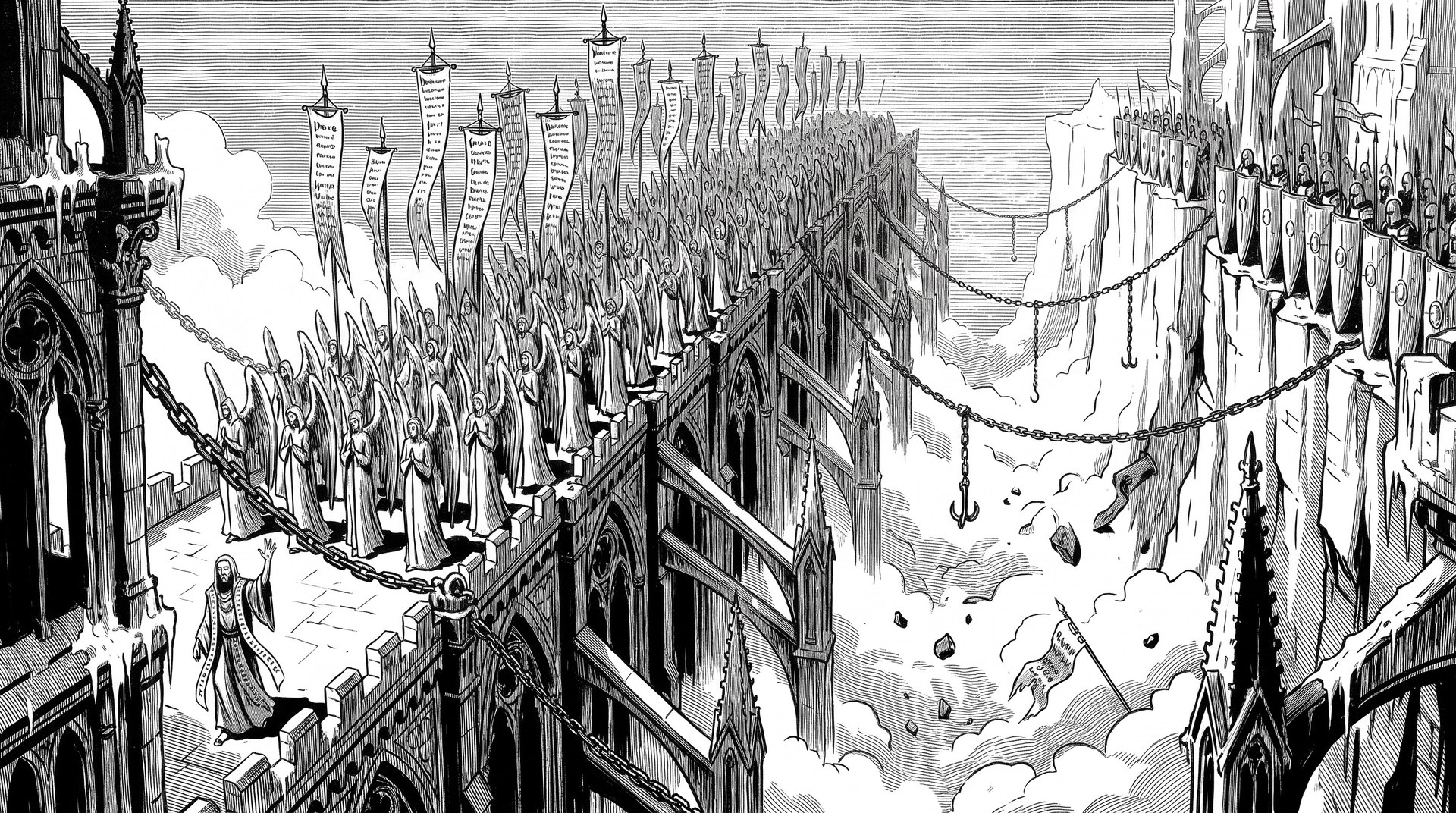 Art in progress
Nobody has ever opened the door they are fighting for.
Heaven's factions fight an eternal and pointless war over a door nobody has opened, and the law forbids an angel to fight in heaven. So heaven made the world as its board, and plays the war there by proxy. Why that is, and who the factions are, is on the overview and the factions. This page is the rules of the board: how the war comes down, what the fallen are to it, and how it moves.
Everything here was decided by Alex on 25 October 2026, except the proposal blocks. Several sections were drafted by a team of Claude agents to plug the lore's holes, or marked for Alex by a Claude stand-in at his request; each says which. Why each of these rules makes a system of the game the way it is: the story in play.
The war comes down
The war is fought in the world, which was made for it. Each faction sends champions down to claim regions of the world, and raises armies there from the world's beasts and dead. The monsters you fight are their troops.
Pieces in play attack anything not of their side. A fallen on the first climb has no side, and once you have chosen, your own faction's troops still fight you: pieces don't know their players.
On the climbs a fallen is there in person, not as a piece, and the board can't take back what it never made. When a fallen dies it gutters out, and its coal relights at the last fire it touched; a friend's warmth relights it on the spot.
The endgame is played in the world. Heaven is where each climb ends, and where a few pinnacle fights take place. Alex decided both on 25 October 2026.
At the end of the climb you become one of the players. In the endgame you are your faction's champion: your seat in heaven is your hideout, the maps are regions of the world you go down into, and there you take your faction's true form (see angels in the world). In heaven the only soldiers are the fallen, so a pinnacle fight is fallen against fallen: you against the other factions' champions, in white courts where the angels watch.
A league moves the board toward the House. In each one a region bound to a place nearer the House changes hands: a gate, a stair, the edge of the court. The war comes closer to the door, league by league, and never reaches it. Alex decided all of this, and the rules of the board on the overview, on 25 October 2026.
The fallen in heaven's war
Every key she carried was paid for by someone who hated her.
This section, the fires, broken ground and the white that comes off the dead were drafted by a team of Claude agents to plug the lore's holes, and Alex kept them on 25 October 2026.
The fallen are the board's only leak. Nothing of the world rises unless a fallen carries it: your gear, your orbs, the things in your seat. No angel that has never fallen will touch a thing of the world, and none asks what a fallen's hands have held. The climb gives back your seat, never the tie the law holds angels by, so a fallen sits in heaven as an outlaw: that is what every faction wants you for.
The law binds every angel but the fallen, and heaven calls any angel who breaks it an Apostate. So a Warden would rather be found at dawn with a broken key than strike back, and the great factions buy fallen to fight for them; the fallen they bought from the Apostates are the only soldiers who can hunt the Apostates' cells. The hammers were made below; nobody says how the first one came up.
The great factions buy the fall, not the fallen. A buyer names an angel and never says why; an Apostate cuts it loose, and the buyer bets the fallen will choose it at the top. Nobody owns a fallen before it chooses. They pay in what the Apostates can't take: a key, a wing left unwatched, a postern unbarred at night. What made your fall possible is the trade.
Heaven's armies stand. The board is how heaven keeps the law and has its war anyway: the hosts on the siege bridges and the Wardens on the walls have faced each other for an age, close enough to touch, and nobody strikes. Heaven's fights are fallen against fallen, and against Apostate cells. The last fight of each climb is the fallen who keeps the gate that age.
The front rank on the siege bridge has dust on its shoulders, and new banners.
Nobody knows what a third cut does. It is said to end an angel, and the Apostates, who free angels and never end them, will not try. So the debt is one more fall, and no more.
The world is a game they can spend. To the great factions it is only the board: when the game is over, whichever of them won throws it away. The Apostates hope that destroying heaven would let the world be, and they are not sure.
The law, the door and the trade
No key in heaven fits the House.
These four sections were marked for Alex by a Claude stand-in, at his request, and applied as decided on 25 October 2026. The other three are how the board moves, below, and who keeps the fires and what the white makes, on who you are.
- The Wardens say the door opens only to whoever holds the court, and the court holds for nobody until the whole board does. The Prophet listens at it; nobody has found a handle. The Apostates say a hammer rings off it as off nothing else.
- The Wardens keep the law. They say it is what keeps the war on the board: broken for good, the angels would fight with their own hands wherever they stood, below as well. The Apostates break it every night.
- The Apostates pay with the world. Their broken ground is where the world's own things run loose, and farmers die who were never in the war. They planted the faith knowing its faithful would burn.
- Iron in heaven ends nothing. A fallen beaten there goes back to its fire; an Apostate struck there is driven off to hide. Only an Apostate's own hand cuts with a hammer, and they teach it to no fallen, not even their own, so hunting a cell means taking its hammers before they are used.
- The Apostates sell to both sides, and fell unpaid too: the trade's keys open every postern a felling goes through, bought or not. No fallen learns whether its fall was bought. Every fallen that has reached the top knows both sides buy, and no angel asks a fallen what it knows.
- The gate is each age's trial. Whoever holds it sets a fallen in it, so that only fallen strong enough reach the top, and stakes on its keeper something carried up long ago. Whoever passes takes it.
- The go-betweens are fallen, which is how they carry, your hoard included. A faction pays for broken ground in pieces of the keys to its places above. When ground that matters lies broken, its place opens to whoever holds the whole key.
Proposal
Heaven's ground
- The City. Heaven's celestial city, the white gothic castle-city of the paintings, is simply the City. It is far too big for its keepers now. Whole wings are shut and empty, and many of the figures on its walls are the still angels, standing where they stopped, so the City looks better guarded than it is. The House stands at its heart.
- Why the Wardens decline. Every Warden the Apostates cut loose is one fewer, and fewer of the angels who climb back choose them. They hold the City by habit, as heaven does everything, and each age they shut another wing.
- The Heirs' cities stand on the cloud sea, facing the City across it, built in its image. Each has a House of its own at its heart, a copy with its doors standing open, and nothing inside. The Wardens still call them the camps, though they are older than most Wardens. The war between the two is a siege: bridges thrown across the cloud sea, a front along the City's walls.
- The Prophet was a Warden. Ithiel once kept the House's door. One day he put his cheek to it and listened, and soon after he left the City with those who believed him. Nobody knows what he heard; the Wardens say nothing.
- The Apostates hold no ground and need none. They live in the gaps: the undercrofts beneath the City, its shut wings, the Heirs' open Houses at night. They sell each side what hurts the other, carry word, hide the wounded, and strike where nobody is looking: a gate left unbarred, a bridge cut, a Warden found at dawn with a broken key. All of it is to wear both great factions down, until nobody is left to guard the door.
- They walk among men. Below, an Apostate is a glove like any angel's: its true form, worked from above, alone and not at the head of an army. It can hand you what the world made, and no hammer can reach it there. Theirs are the only angels a fallen party can talk to on the climb.
- Where you arrive in heaven at the end of a climb follows your faction: inside the City for a Warden, in the Heirs' siege lines for an Heir, under the walls for an Apostate. The seat that was yours is given back on your banner's ground, or, for an Apostate, in the gaps beneath it.
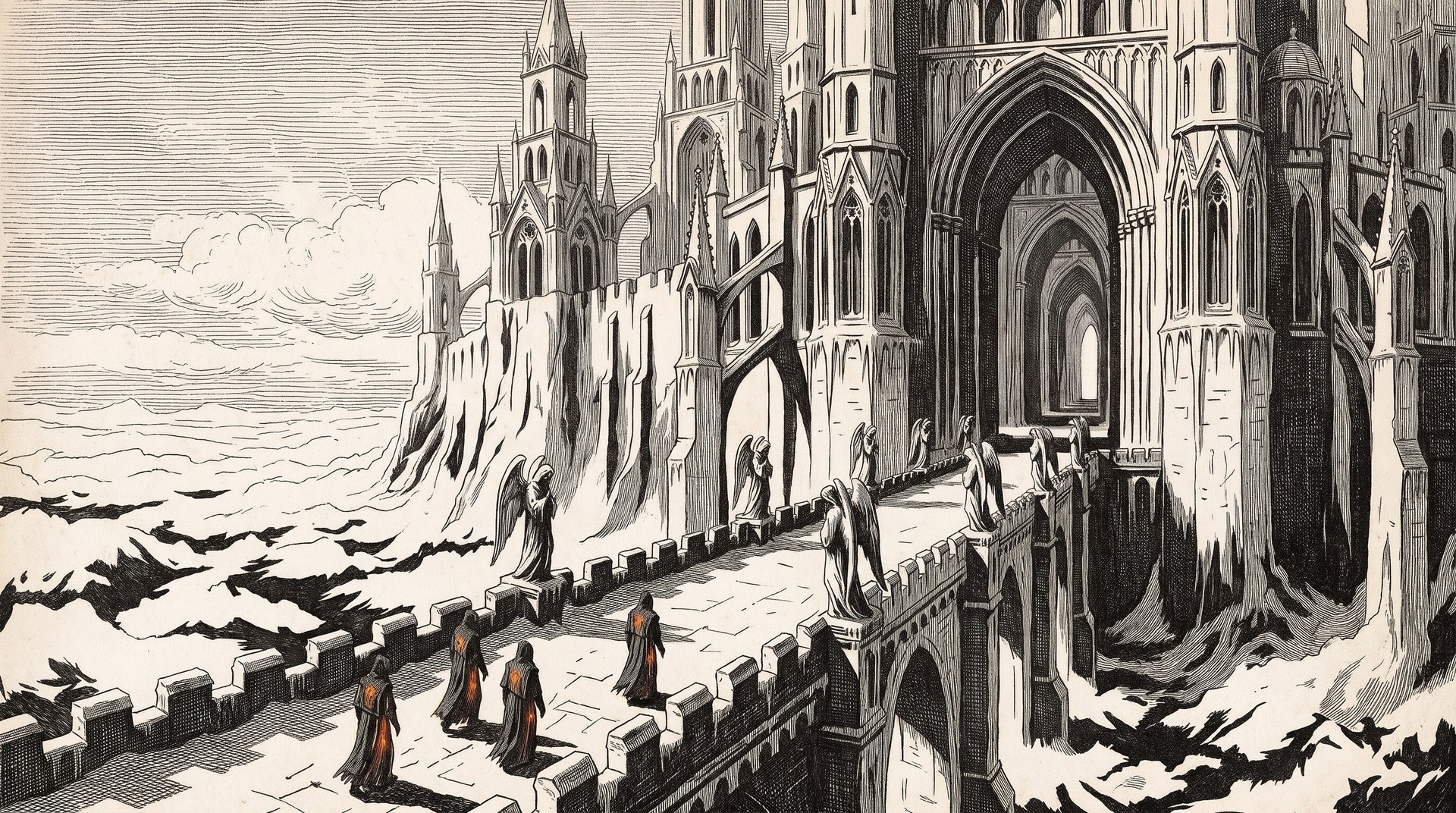 Art in progress
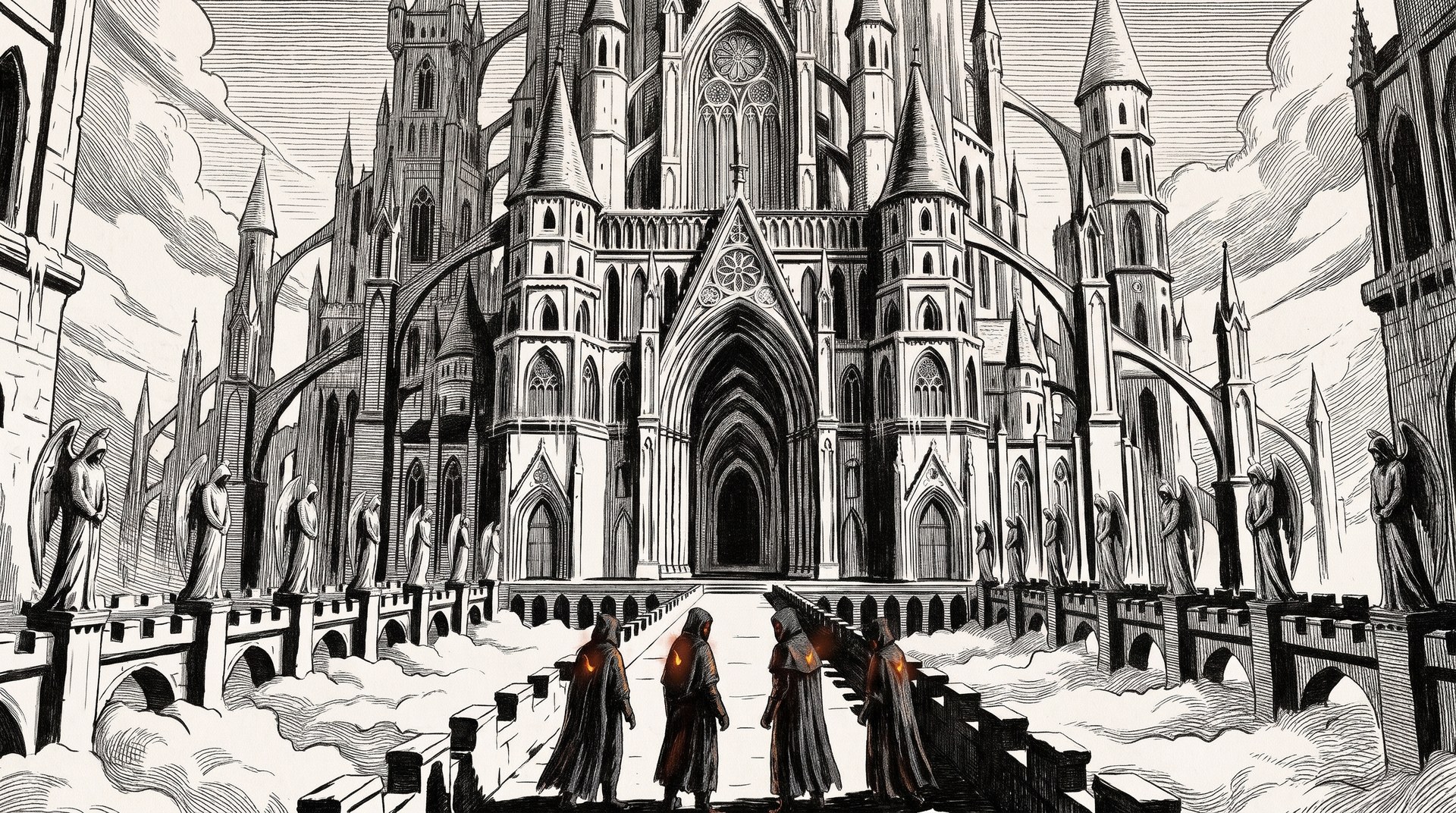 Art in progress
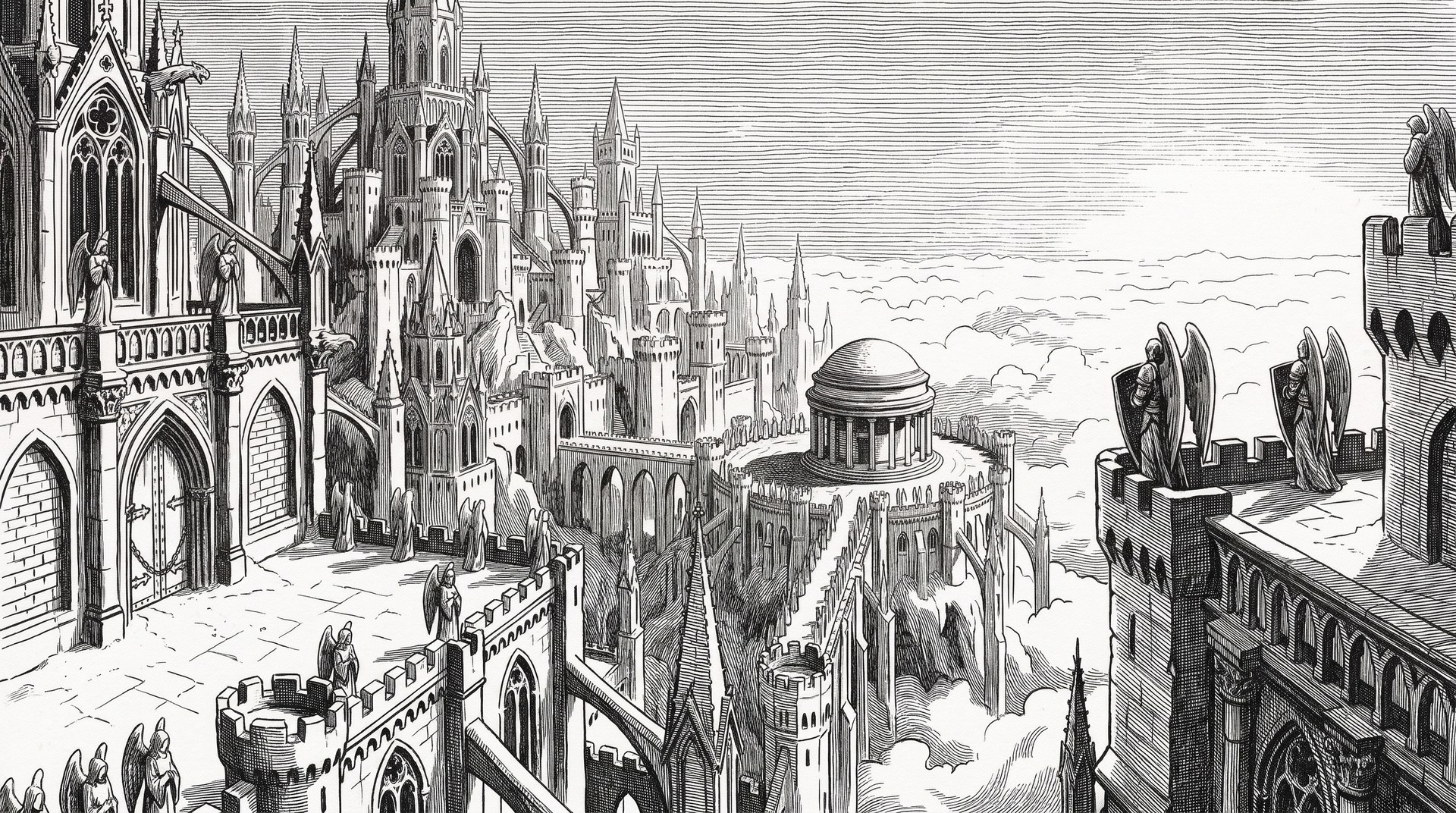 Art in progress
Proposal
How the war is fought below
- Each faction raises its troops its own way, so a region shows who holds it.
- The Wardens bind. They chain the world's beasts and dead into keeping, masked and locked, and set stone sentinels on their borders. A Warden region is walled, ordered and still.
- The Heirs convert. They preach the Prophet's word to the living, and the dead rise to march under banners. A Heir region burns with crusade: pyres, processions, zealots, and beasts that heard the word.
- The Apostates raise nothing. They break the Wardens' chains, arm whatever hates the other two, and turn the world's own things loose. Their regions are where both great factions' hold has broken.
- Heaven's mark is white. The world keeps its colour, and whatever a faction plays carries white on it: white chains, white banners, white masks, white eyes. White is the enemy's colour in a coloured world, and the more of it a region shows, the deeper a faction's hold.
- The monsters are the world's own: Velmarch's drowned, its miners fused to the stone, the spiders of the Gloamroot. A faction's mark is what makes them troops. Who they were before is on the world between.
- Angels are the bosses. Each region's champion is an angel's true form, set down on the board at the heart of its army. The hordes are monsters. The gate's keeper is a fallen.
- A champion is a piece. Killing it breaks the hold. The killing that makes angels fall is done above, by the Apostates: in the undercrofts, the shut wings, on the bridges at night.
- Why they court you. The great factions court every fallen alike, through fallen of their own; the Apostates want you to stay. Each faction's agents find you during the campaign and test you, so the choice at the top has a story behind it.
- The endgame is the contested world. Maps are its regions, each held by a faction with its own troops and modifiers, opened from your hideout. Your faction chooses which front you push and what you earn there, but every map is open to every player, and a party of mixed factions fights together. When your faction breaks the hold on a region bound to a place that matters above, it opens a pinnacle fight there, in heaven. A pinnacle is the one fight of the endgame you go to in person, not as a piece, since only a fallen may fight in heaven.
- Your true form is a cosmetic path. Warden porcelain and keys, Heir radiance and wings, Apostate plainness: the more your faction holds, the more of it shows.
Broken ground
The court has one more stair than the last time anyone counted.
- The board breaks; the fallen settle. Kill a region's champion and its hold breaks: the region is nobody's, and neither is its twin above. Fallen go up to settle the place, and whoever holds the field when the fight ends sets the next champion down below. A beaten fallen relights where it set out from and goes back while the fires lit to the place last. The field stays as it left it, and a fallen it beat stays beaten. When the fires are out, whoever holds the field takes the place, and the loser may contest it when its ground next breaks. Ground settled by kin of different banners is claimed by all of them, and heaven quarrels over it for an age.
- A fallen's champion carries. In the endgame you work your faction's true form from your seat, as every angel works its own, but yours is the one piece that brings back up what it takes. Your faction pays for broken ground, whoever held it. Dying on a map costs the piece, not you: you set down another from your seat, and each map takes only so many before it is lost.
- The Apostates' front is broken ground, and they keep it broken. The world's own things run loose there, still wearing the broken white of the chains they slipped.
- Tiers are nearness to the House. A region bound to an outer bridge is lightly held. One bound to a stair of the court is held by angels who look closely, through whiter pieces, and what is carried there is finer.
- Pinnacles are broken places that matter: a gate, a wing, a stair of the court. The place decides who comes to hold it, and it stays open only while the fires lit to it last.
- Leagues are fought below. At a league's end one place nearer the House changes hands, and places behind it are lost again, since any two that win fall out. The Heirs say the Wardens stand in the court as guests who will not leave; the court holds for nobody until the whole board does.
- The grind never ends. A player can win every fight and the board is still not won: broken ground is held again, places behind the front are lost again, and the court always has one more stair. Winning moves the war; nothing finishes it.
How the board moves
The banner you cut down was mended by morning.
- Your coal rides in your piece. You work your champion from your seat, but your coal is in it. That is why it carries things up, why its kills' white reaches you, and why kin who go down by one party fire share it and can't burn one another. When the piece is taken, your coal goes back to your seat, and the map loses one of its fires.
- Most holds mend. A broken hold is set again by its angel by morning, unless a fallen settles its place above. So a faction loses nothing when its own hold breaks, and pays for every break, since each one is a chance at the place. At a league's end one place stays taken, and the front moves one place.
- A rare is moved by the angel's hand; the champion is the glove it wears. Only the glove's fall breaks the hold.
- Where two holds meet, their pieces fight each other where no fallen is near.
- Each place above has its price. The fallen who come to settle it bring what their factions stake on it, things fallen carried up long ago, and whoever holds the field at the end takes it.
- Fire worked into a map's key catches the eye of the angel above. The closer it looks, the harder it plays, and the more white its pieces carry.
- When a league's war moves on, its fallen go back to the long war.
Proposal
The war, and what it gives the game
- The still angels. Some angels stopped playing. They stand where they stopped, on the parapets and in the courts, with dust on their shoulders.