
Painting guide
How the game's concept paintings and painted game art are made, all in one house style, the engraving, frozen from the style study. The tool, the frozen references for each register, the prompt rules for heaven and the factions, and the looks the paintings have settled.
 Art in progress
Describe the shape, not the idea: "upside down" alone gives an upright ship.
Every new painting is made in one house style, the engraving: Gustave Doré's hatching and
cross-hatching, deep engraved blacks, the paper for light, and a restrained hand-tinted wash only
where a scene has colour. Alex chose it on 26 October 2026 from the style study,
because the paintings had drifted into two styles that read as two games. Its references and words
are frozen in design/style/style.json, and the tool sends them with every painting. The rest of
this page is how to paint in it. This page is for whoever paints next, person or agent. What the paintings must show
is the visual identity, the palette and the
shape language; the kept paintings of the new registers are on
concept paintings; this page is how to get there.
The tool
The paintings are made with Gemini's image models, Nano Banana Pro (gemini-3-pro-image) by
default, through design/tools/imagegen.py. gemini-3.1-flash-image is cheaper and faster, for
drafts.
/usr/bin/python3 design/tools/imagegen.py --style heaven \
    --out www/art/paintings/heaven/the-gate.jpg --aspect 16:9 --size 2K --prompt-file prompt.txt
- Always paint with
--style REGISTER. It sends that register's frozen reference paintings first and adds the house style words to the prompt, so the prompt only describes the scene.--style listlists the registers (below). Without--styleor--refthe tool warns that the painting will not match. - Extra
--refimages go after the style's and are for content only: a character to keep, a place to repaint. Say so in the prompt ("the last attached image is Sereth; keep his face and gear"). - To change one thing in a painting you like, pass that painting as the only
--refand ask to "repaint the attached painting, keeping its camera, composition and style exactly, with one change". This is how the bridge into heaven and shot 3's gate were fixed. --aspecttakes 16:9, 1:1, 3:4 or 9:16;--size1K, 2K or 4K;--modelpicks another model, and--listlists the image models.- The key comes from the environment (
with-secrets) or from.env.localat the main checkout. Never paste it anywhere. Use/usr/bin/python3: the python.org build has no CA certificates. - Paintings live in
www/art/paintings/, inzones/,characters/,monsters/,heaven/,factions/andchampions/beside the key art, and are served atart/paintings/.... Save the site's copy at 1920 pixels wide.
The house style
 Art in progress
 Art in progress
 Art in progress
 Art in progress
 Art in progress
One frozen reference per register, in www/art/style/, with the words for each in
design/style/style.json:
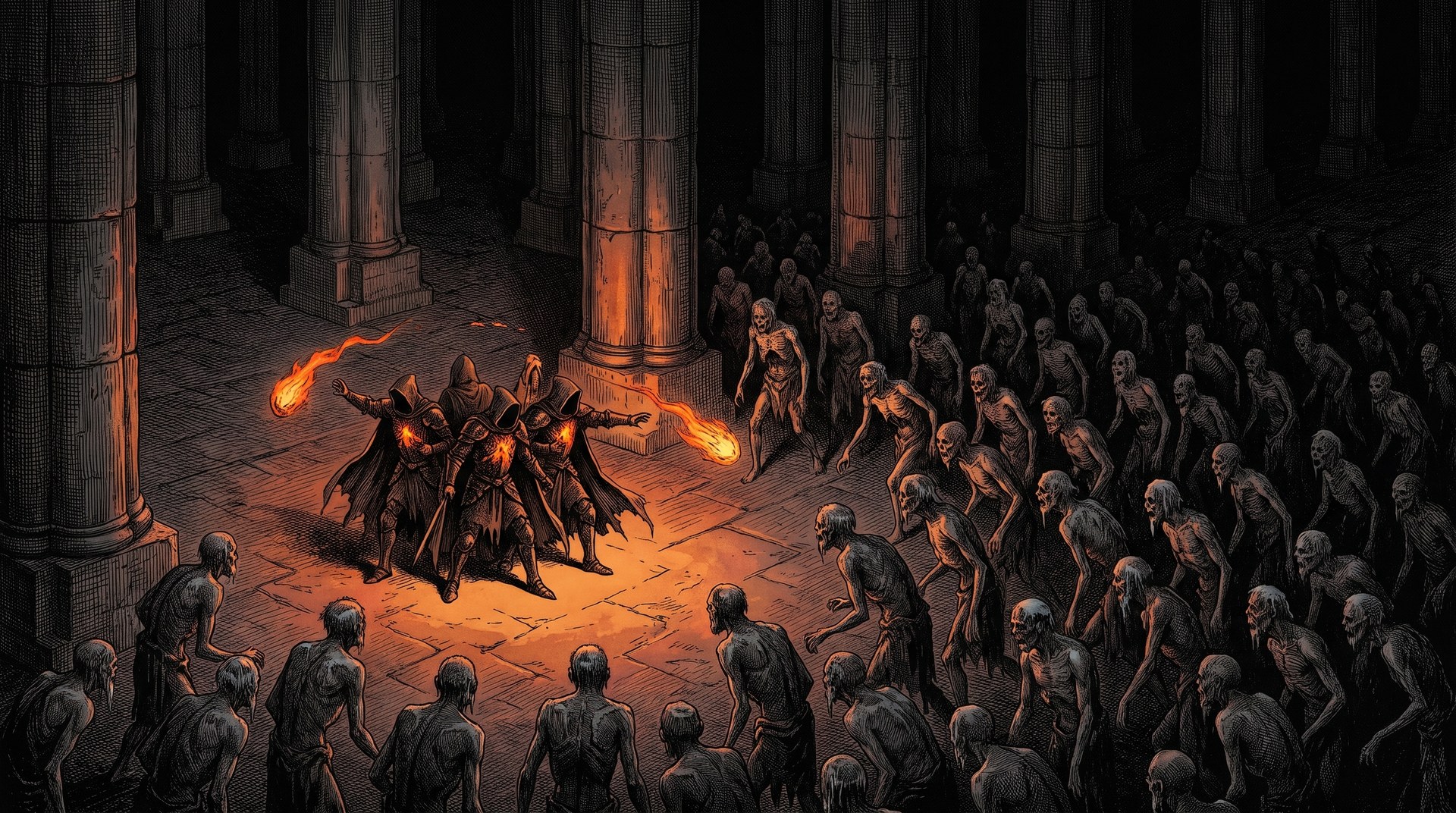
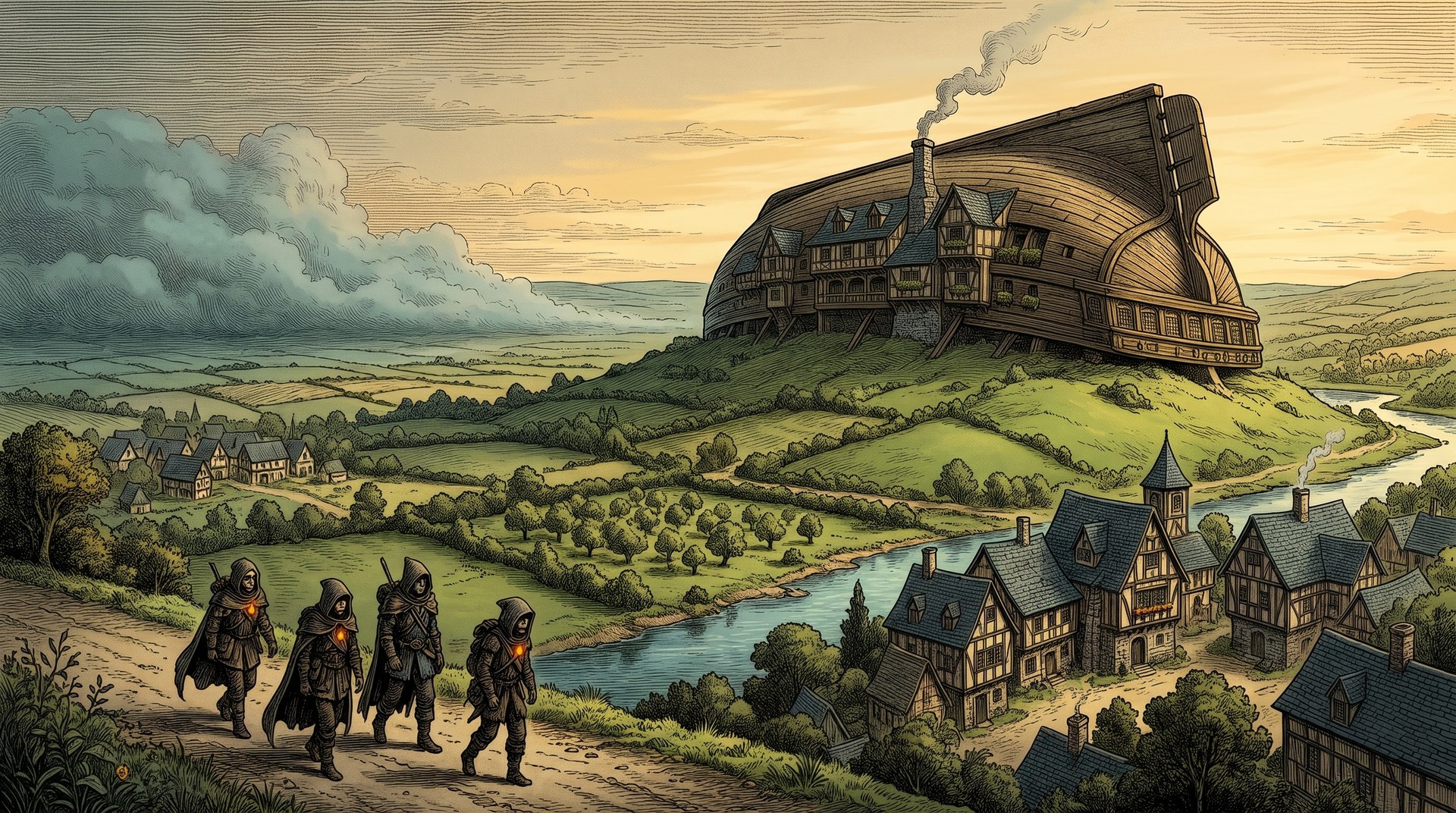
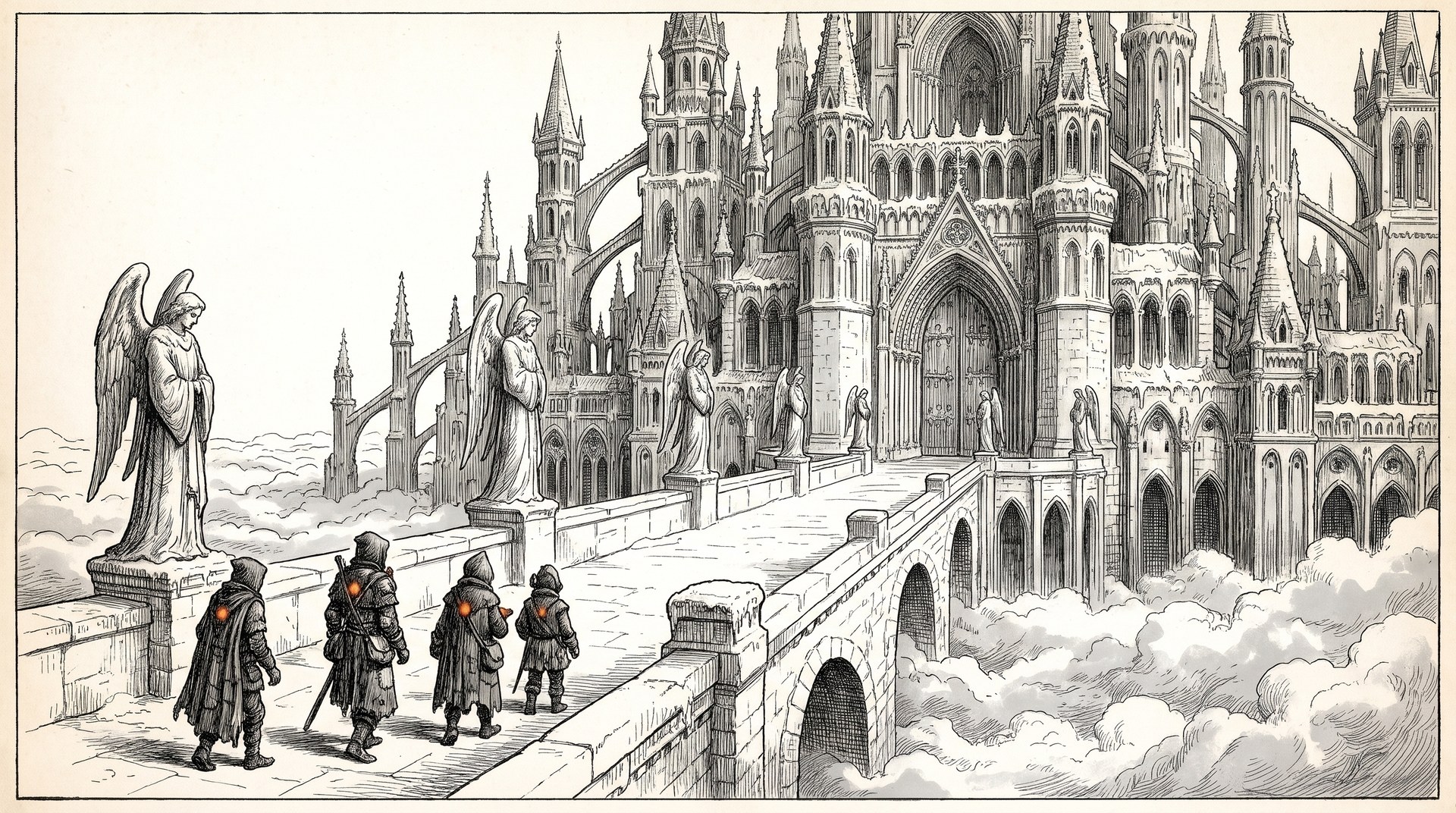
deep: caves, the Underhalls, the Heartfire, anything underground. Four fifths of the frame in engraved near-black; the embers, fire and loot the only colour.world: the daylit world. The engraving hand-tinted in the world's colours, the distance in lighter, sparser hatching.heaven: the City, the gate, angels in heaven. Untinted engraving on white paper; the fallen's embers are the only colour.faction: the world under heaven's white (an angel's true form, its troops, a faction-held place). The world tinted, and whatever is heaven's left as bare white paper, so the white reads as the enemy.figure: one character or monster head to toe, for portraits, model sheets and the wiki. The fallen wear dark gear hatched into near-black, with the ember the only orange.
Changing the style is changing these files: a new reference replaces one in www/art/style/
only when Alex keeps it, and the words change in style.json in the same commit.
Prompt rules for each register
The style words come from --style; the prompt says what is in the scene and how it is lit.
- The deep (
--style deep): seen from a high three-quarter camera like the game's, Darkest Dungeon dread. If the frame comes out too light, add a vignette and a shadow curve until about 80% of it sits in the two darkest values. - The daylit world (
--style world): a high vantage point, tiny figures, one focal light, and one wrong thing on the horizon. Under the sea and on the seabed, the same forms under uncanny light: grey fog, blinding glare and mirage. - Heaven (
--style heaven): below. - The world under heaven's white (
--style faction): below. - The party is four fallen, the co-op maximum, hooded and cloaked in dark layered gear, and they carry embers only, never torches. The ember is their light, and it glows at the chest, in front.
- Describe the shape, not the idea. To get Hearthold's upturned hull, write "wide gunwale on the ground, hull narrowing up to the keel like a roof ridge, rudder pointing up". "Upside down" alone gives an upright ship.
- Keep the palette. Each region's colours are on the palette. In the deep and in heaven, warm colour is only for the party, loot and fire.
- No text. End every prompt with "No text, no letters, no readable words": banners and robes written with script still come out as script, without letters to misspell.
Painting heaven
Describe heaven with one block of words, after the scene, so it stays one place (the style comes
from --style heaven):
Exuberant, phantasmagorical medieval gothic: every surface dense with intricate carved detail,
tracery, pinnacles, crockets, gargoyles, pointed arches nested in pointed arches, flying
buttresses across empty sky, towers stacked on towers like coral and frost, white wax dripping
from cornices, impossible scale and heavy mist. Heaven has no colour: black line, white and pale cold
grey only, no gold, no blue, no warm tones.
And for the scene itself:
- Say "no colour" twice. Once in the style block, once by naming the only exceptions: "except the four small orange embers, which are the only colour in the picture". The model adds gold to anything holy unless told not to.
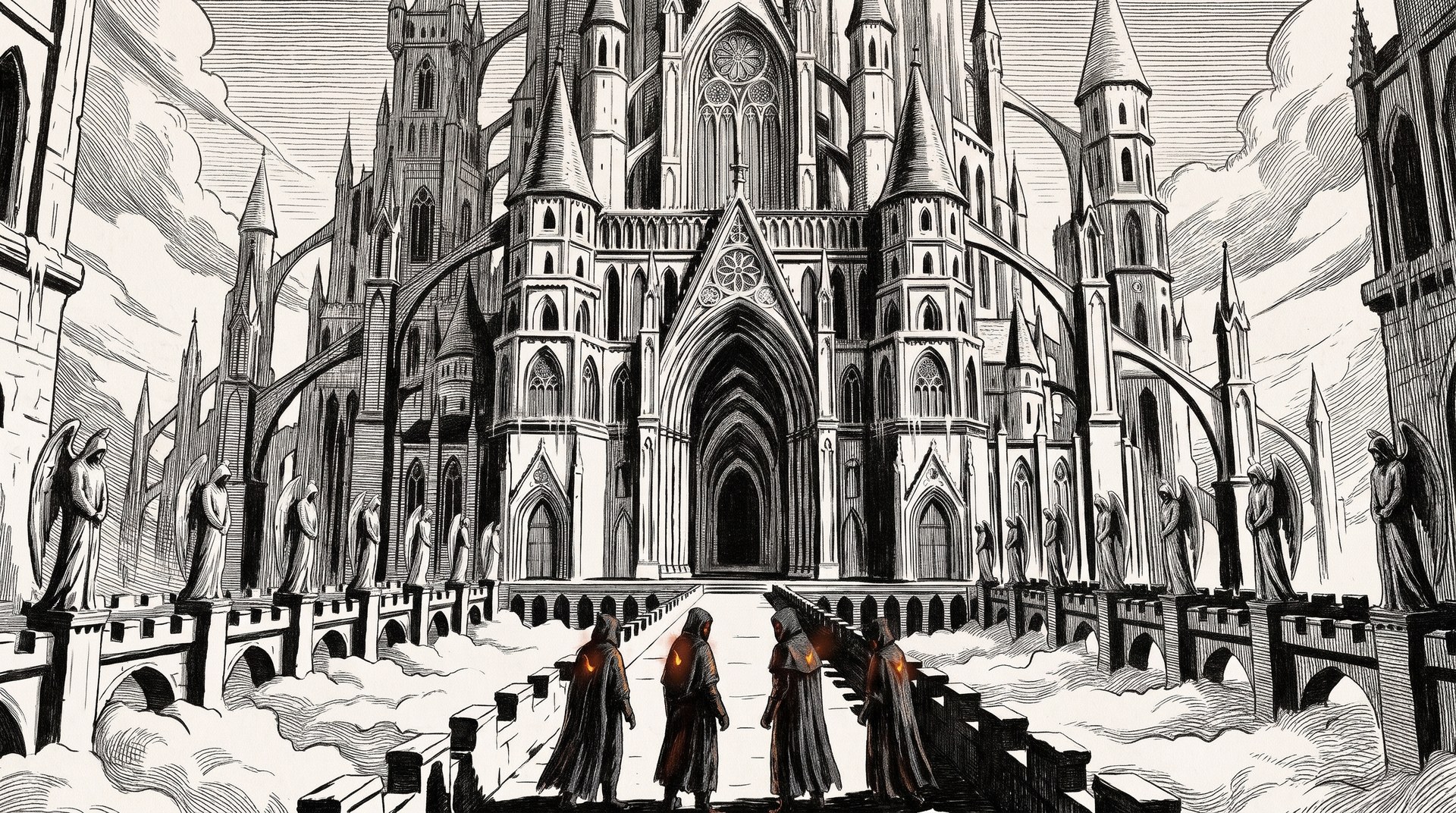
- Medieval gothic, not French classical. Crenellated walls, towers with conical roofs, walls like cliffs over a sea of cloud. Name no real building except the House's model, the Pantheon.
- The House is "a plain round domed house like the Pantheon in Rome: a smooth windowless drum, a low heavy dome, a portico of plain columns, tall doors shut. It is the only round, smooth, classical thing in a gothic heaven, small and plain, and nothing touches it." It never shows on the party's first arrival: through the gate, only arches receding into white.
- The wrongness is subtle. Ask for it by name and keep it quiet: windows carved on solid stone, wax dripping from pinnacles, far too many doors and none open, symmetry almost perfect but slightly off, angels perfectly still with white dust on their shoulders and wings, every shadow leaning toward the House. Nothing is ruined.
- The still angels are "tall angels in robes standing perfectly still, dust on their shoulders, every one facing the gate (or the House), none looking at the travellers". Without that last part they turn to look.
- Heaven's dark (the undercrofts beneath the City) keeps the same style words and no colour, but low key: vaults in shadow, one shaft of light from a crack above.
Painting the factions
Each faction has a silhouette, a wing pose and a white of its own. Put all three in the prompt, in these words, and the faction reads at a glance even without colour.
- Wardens in heaven: "broad armoured angels with wings folded tight down their backs like stone cloaks, tall tower shields planted, all facing outward" (never toward the House). Their City is "far too big for its keepers: whole wings shut, windows bricked up, doors chained, courtyards drifted with white dust", and among thousands of still angels the living Wardens are "few and far apart".
- Heirs in heaven: "tall thin angels with wings raised high above their heads, marching in long ordered lines like a procession, under a forest of tall narrow banners written edge to edge with dense illegible script". The Prophet is "gaunt, his robes covered in the same script, one hand raised", at the head of the host. Their siege bridges are "built like the skeleton of a gothic cathedral nave laid on its side, ribs and buttresses and chains, unfinished at the far end".
- Apostates in heaven: hooded angels with short wings, each with a hammer made below, in the gaps: undercrofts, shut wings, a postern unbarred at night. Never in ranks; in a ring, or alone.
Painting angels in the world
Paint them with --style faction, and name what is heaven's in the scene, so the tool leaves it as
bare white paper: "whatever belongs to the angel (its body, its chains, banners, masks) is heaven's
white". The world's people are tinted in earthy reds, browns and greens.
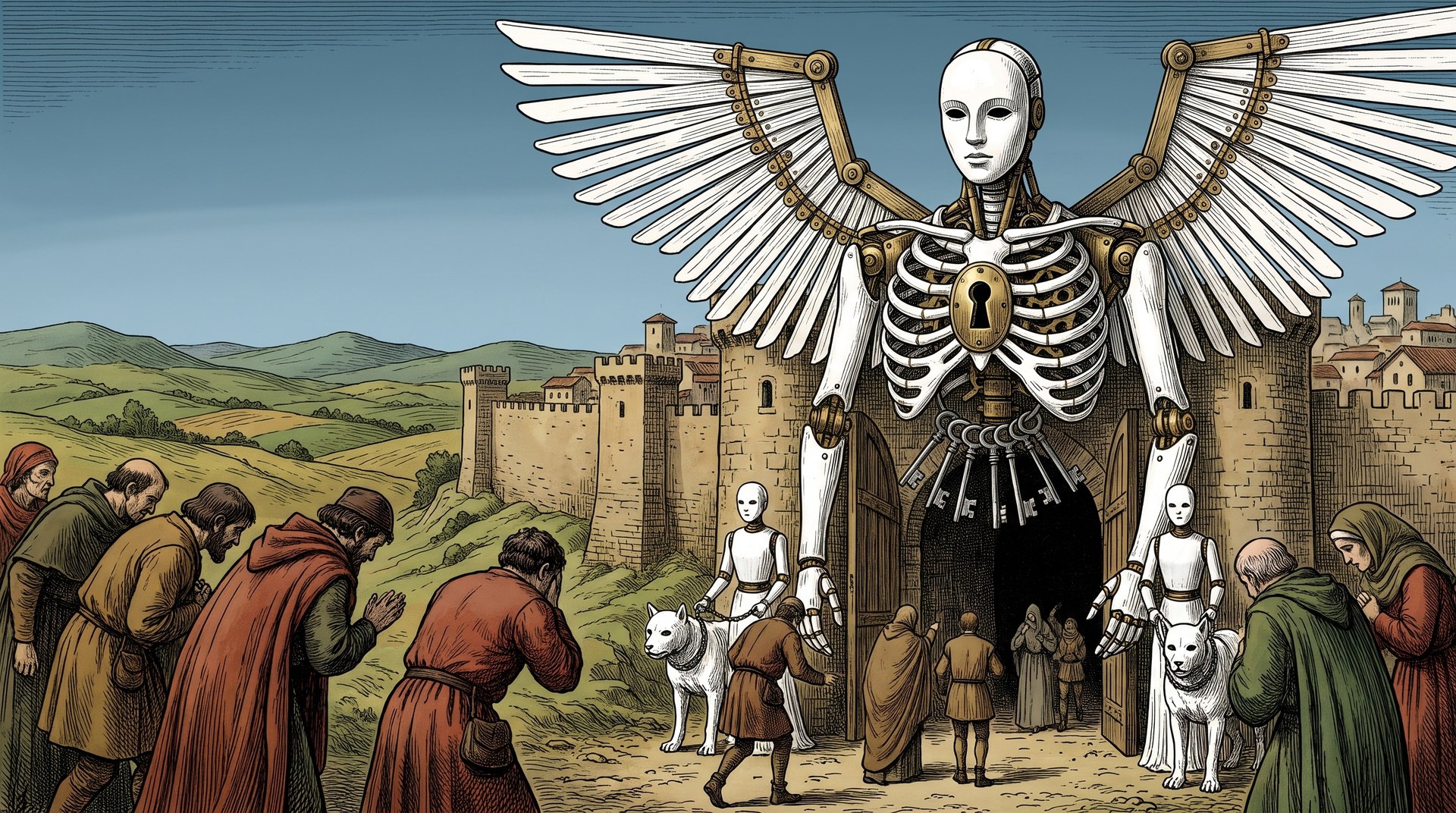
- The Warden's true form is lifeless: "a tall automaton, a puppet-saint of white porcelain and carved bone-white wood joined with brass pins and clockwork, its face a smooth blank mask with no eyes, its chest a hollow cage of white ribs with a great keyhole where the heart should be, a ring of keys turning inside like gears; its wings stiff fans of white wooden slats on hinges". Around it, smaller white puppets, stone sentinels and chained beasts in white masks.
- The Heir's true form is godlike: "a colossal radiant figure as tall as a cathedral, robed in white written edge to edge with tiny script, six vast white wings, two raised high, two folded over burning faces, two spread wide; a face too bright to look at, crowned with fire; great interlocking wheels rimmed with eyes turning around its head". Below it, zealots and risen dead in white under white banners. "Biblical splendour and terror, not gore."
- The Apostate's true form is human: "a weathered man (or woman) in a plain hooded cloak and leather, a heavy iron sledgehammer made by men over the shoulder, an ordinary tired face. Only his shadow on the wall behind has the shape of great broken wings." Around them, people of the world breaking white chains and white masks.
- The world's people carry no white. Townsfolk, peasants and rebels wear earthy reds, browns and greens, and they bow, kneel or look away; only what an angel plays is white.
Looks the paintings settled
These are fixed now. Repaint them the same way.
- Where you wake: a cave floor deep in grey feathers, cold embers scattered across it, one grey shaft of light from far above, and the fallen sitting alone with the ember at its chest.
- Heaven's gate: pointed arches nested inside pointed arches, receding without end into white. The House: small, plain, round and shut, alone in an empty court that the processions stop at.
- The Doorward: a Warden with his back to the House's doors, a crowned helm, folded wings and a tower shield carved with the City; the doors behind him chained and padlocked.
- The Warden champion's keyhole heart, with keys turning inside; the Heir champion's wheels and script robes; the Apostate champion's winged shadow.
- Orrin: drowned but dignified, not a skeleton. Grey-teal salted skin, kelp in his beard, a crown of branching coral with old gold showing through, a flooded throne.
- Maudra: lit from below by the Hearth, holding iron tongs.
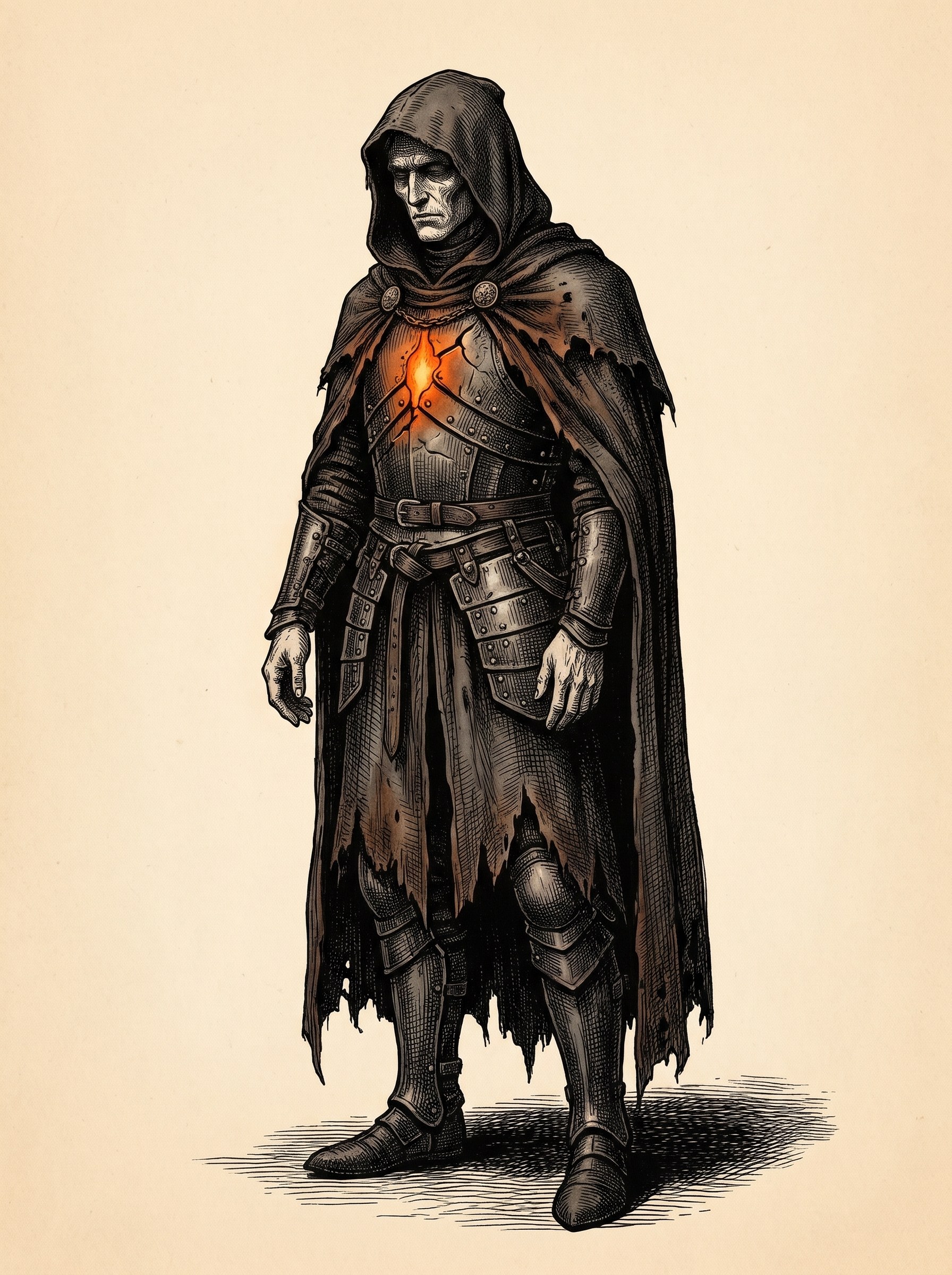
- Sereth: ash-cracked skin, and a dead grey cinder behind a cracked breastplate; head to toe, a hood and a long cloak burnt at the edges.
- Ilse: offers a glowing bowl of seawater; salt at her lips, vials on her belt.
- The monsters: the drowned have a frost-rimmed hollow where the ember was, the Gloom Spider is eyeless with a belly of stolen light, the Cavern Brute wears its helmet and pick fused into its rock. See shape language.
- The Tidewall: a giant sea-gate standing open among the drowned spires of Saltreach.
- Hearthold: the Crowned Gull keel-up on a green hilltop, with galleries, dormers and window boxes built into the hull, a market around it, and the Hearth's glow through a great doorway.
- The Unlit: the cyan specks in the void form two vast eyes. This one was invented by a painting: it raises the stakes of what is under the fire without answering it.
To redo
- The key art of the journey shows a party heading down; the new key art shows the climb.
- The Last Hearth should read as a coal the size of a house, not a fireplace.
- The pillars of the Underhalls should be bigger: halls too large to see across.
- No torches. Any party carrying one is repainted with embers only.
- The daylit landscapes are only partly engraved: the Barrow Moors, Hearthold, the Vale and
Harrowwood kept some of their painted softness when the older paintings were repainted on
26 October 2026. They want a fresh painting from their description with
--style world.
Repainting a painting in the house style
Every painting made before the house style was repainted on 26 October 2026, keeping its
composition. To repaint another, pass it as the extra --ref with the register's --style, and
prompt: "Redraw the last attached image from scratch as an engraving in the house style: every form
drawn in hatched and cross-hatched line. Keep exactly its camera, composition, figures and poses,
its value structure and its colours. Do not add any colour, light, figure or object it does not
have. Where the house style's words disagree with the original, the original wins." Then name what
the model gets wrong in that one (a dead cinder that must not glow, a shadow that must stay a
shadow). Painted originals resist: if the take still looks painted, add "it must look like the
first attached image, an engraving, and not like the last, a painting".
Heaven's hand in a painting
Ink is the war's line (decided on 26 October 2026, at Alex's request): in the game an ink outline marks heaven's pieces (see visual identity). In the engraving everything is line, so a painting marks heaven's hand with its white instead: what heaven plays is left as bare untinted paper, the world around it is tinted, and in heaven nothing is tinted but the fallen's embers.
Model sheets and painted game art
The same tool makes production art for the game.
- Model sheets. Each target shot gets painted reference sheets for its
models: turnarounds of one figure in five views on one ground line, on a flat Soot background,
with the key art as style reference. They are references for low-poly models seen from the game's
camera at 40 to 70 pixels tall, so the prompt asks for the big shapes of the head, shoulders and
back, and no detail that would vanish at that size. Prompts and sheets go in
design/target-shots/concept/<shot>/. - References for image-to-3D. A character to be made into a model is painted head to toe, in a
neutral A-pose with the arms clear of the body, in flat even light on plain light grey, with its
finished painting as
--ref, like Sereth's. The steps are indocs/art.md("Characters from image-to-3D"). - Painted game art. Anything sculpted, figurative or textured, such as statues, reliefs,
ornaments, portraits and icons with depth, is painted, not drawn: hand-written SVG does not reach
the game's style and is kept for geometry such as rings, frames, plinths and bars. Alex decided
this on 24 October 2026. The prompt asks for one subject, lit from the upper left, nothing cut
off, on flat magenta (
#FF00FF).design/tools/hud_art.py gen NAME --takes 3paints the takes, Alex picks one, andhud_art.py cut NAME Nkeys out the magenta and fits the piece into the client. The full steps are indocs/art.md.