Visual identity
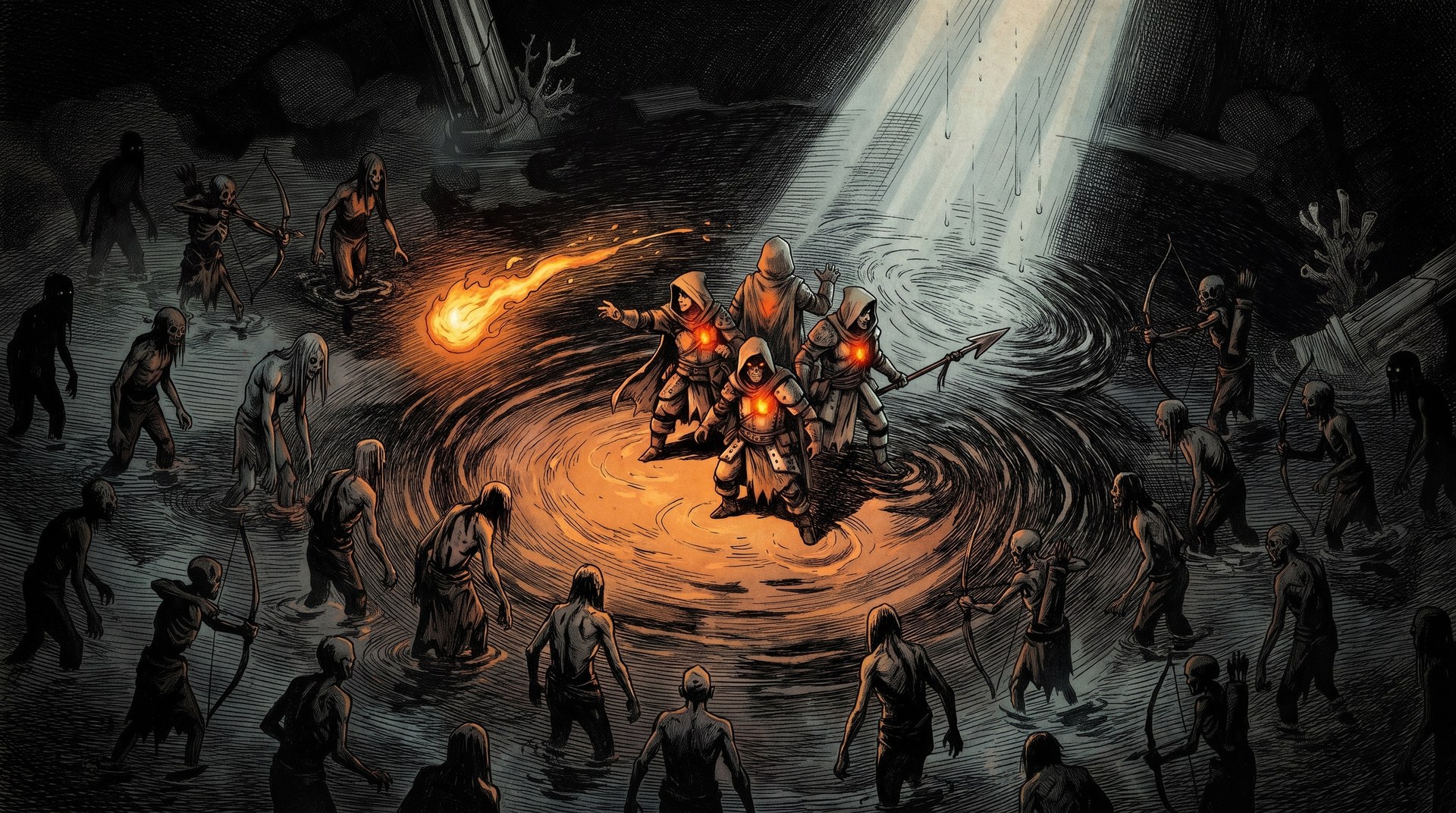
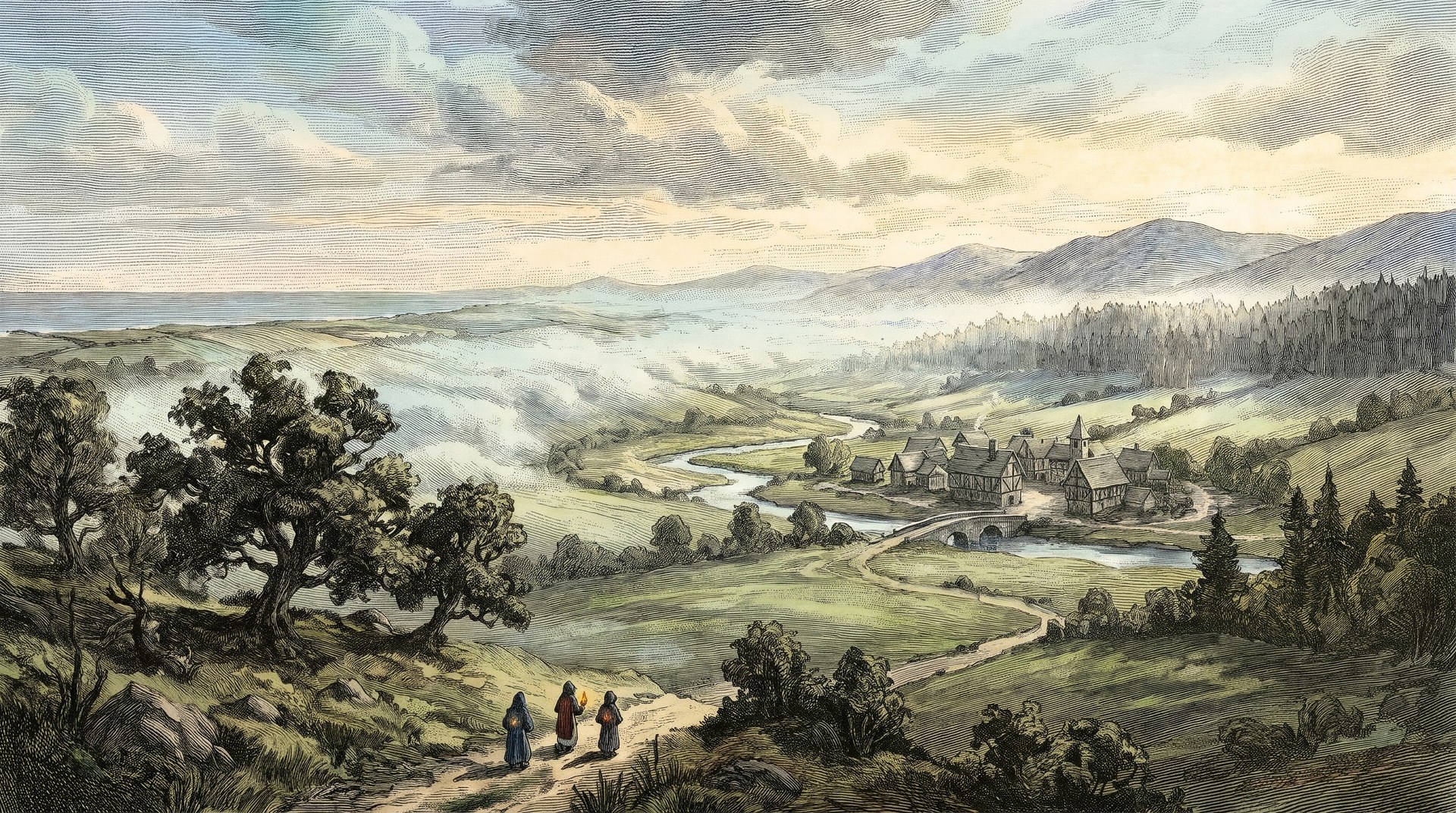
The look of the climb. Ember-noir in the deep, Romantic landscape in the world between, a heaven drawn white in ink at the top, and heaven's white on whatever a faction holds. Warm fire is the fallen's own colour throughout, and a horde of two thousand still reads at a glance.
 Art in progress
The higher you climb, the less colour is left.
You wake at the bottom of the world with a coal in your chest and climb back to heaven (see the overview). The look follows the climb. It starts in a near-black deep lit only by the ember you carry, comes up into daylight through the drowned kingdom of Velmarch, and ends in a heaven that is white, gothic and has no colour at all. Through all of it the ember is the fallen's own warm colour, and a crowd of two thousand monsters has to read at a glance from above.
This page is the game's art direction. It applies to the game, to this site, and to anything else that carries the name. The colours are on the palette page, the shapes of monsters and angels on shape language, the reference paintings in concept paintings, and how they are made on the painting guide.
What is decided and what is not. Alex decided on 25 October 2026 that the climb goes up, that heaven is white gothic drawn in ink with no colour, that white is the colour of evil, that the world below is dark with some colour, and how each faction's angels look in the world. Those parts are marked as decided below. The curve that ties them to the acts, and everything else on this page, is a proposal.
The curve turns over
The old direction drained the light away as you went down. The climb turns it over: daylight comes back as you rise, and at the top the colour goes.
 Art in progress
 Art in progressArt in progress
 Art in progress
Proposal
| The deep (act 1) | The world between (act 2 and the foot of act 3) | The heights and heaven (the top of act 3) | The contested world (endgame) | |
|---|---|---|---|---|
| Where | Where the fallen wake, the Underhalls, the Cinderworks, the Heartfire | The Drawn Sea and the Drowned Coast, then the Vale, Hearthold and Harrowwood | The Barrow Moors and the High Pass, above the clouds, then the gate and heaven | The world's regions as maps, each held by a faction; pinnacle fights in heaven |
| Tradition | Mignola shadow, ink, Darkest Dungeon dread | Romantic landscape: Turner, Friedrich, Bierstadt, as film concept art | Doré's engravings, the Falconia of Berserk, Nihei's impossible architecture, all in ink | The world's tradition, inked, with heaven's white laid over it |
| Light | The ember alone; slag uplight; the Heartfire overexposed | Grey fog under the sea, glare on the seabed, then golden afternoon | Wind and snow, then cold white light from no source | The world's daylight; whiter the closer a map's place stands to the House |
| Values | About 80% of the frame in the two darkest values | Full range, atmospheric perspective | High key: most of the frame in white and pale grey, ink for every shape | Full range; heaven's white is the brightest thing on the map |
| Colour | Black, ember, gold, cold tide accents | Slate and verdigris, salt, then greens, wheat and sky | Snow and Rime, then none: chalk, bone, silver-grey | Greens, ochres, earthy reds; bone-white chains, masks and banners |
| Strangeness | Phantasmagoria: halls too large to see across, a floor of feathers | The world bends: drowned faces, mirages | Quiet wrongness: still angels, too many doors, wax dripping from gilding | The war's marks on an ordinary world |
The first acts are where the eye learns the ember: a warm light in a black world. By the time the party reaches heaven, the ember is the only colour in the frame, and the player knows what it means. The game spends its ink at both ends: the deep and heaven are both inked, the deep in black, heaven in white, and the landscape between is painted.
The second climb goes up through the same acts a hundred years on. The proposal is that it keeps each act's register and shows the faction you chose: more white where your faction holds the region harder, more broken white where the Apostates broke it wider, and the fires you lit last time long out.
The current build only shows the deep so far: a black clear colour, fog closing in around the
party, a warm spotlight on the player and a cold blue fill (crates/client/src/world.rs). The
daylight acts need a sun, a sky and softer fog tinted by each region; heaven needs a high-key
exposure, flat shading and an ink outline pass, with the same readability rules.
Ink is the war's line. Decided on 26 October 2026, at Alex's request for the call best for the game: whatever is heaven's is drawn in ink in the game. Below heaven, the ink outline goes on heaven's pieces only (angels, faction troops, what a fallen raises, heaven's architecture on the ground a faction holds), and the daylit world's ground and plain monsters stay painted without it. In heaven every shape is inked. A player reads the line at a glance, on any background and in any crowd: an outline means heaven is playing that piece. It also keeps the outline pass to the meshes that carry it, rather than the whole frame. Paintings are all in one house style, the engraving (style study), where heaven's hand is the bare white paper instead; their rules are on the painting guide.
Heaven
Decided by Alex on 25 October 2026, when the climb's end became heaven:
- White is the colour of evil. The game turns the usual custom over. Heaven is white and has no colour at all; humanity and the world below are dark, with some colour. The ember the fallen carry is the warmest thing in heaven.
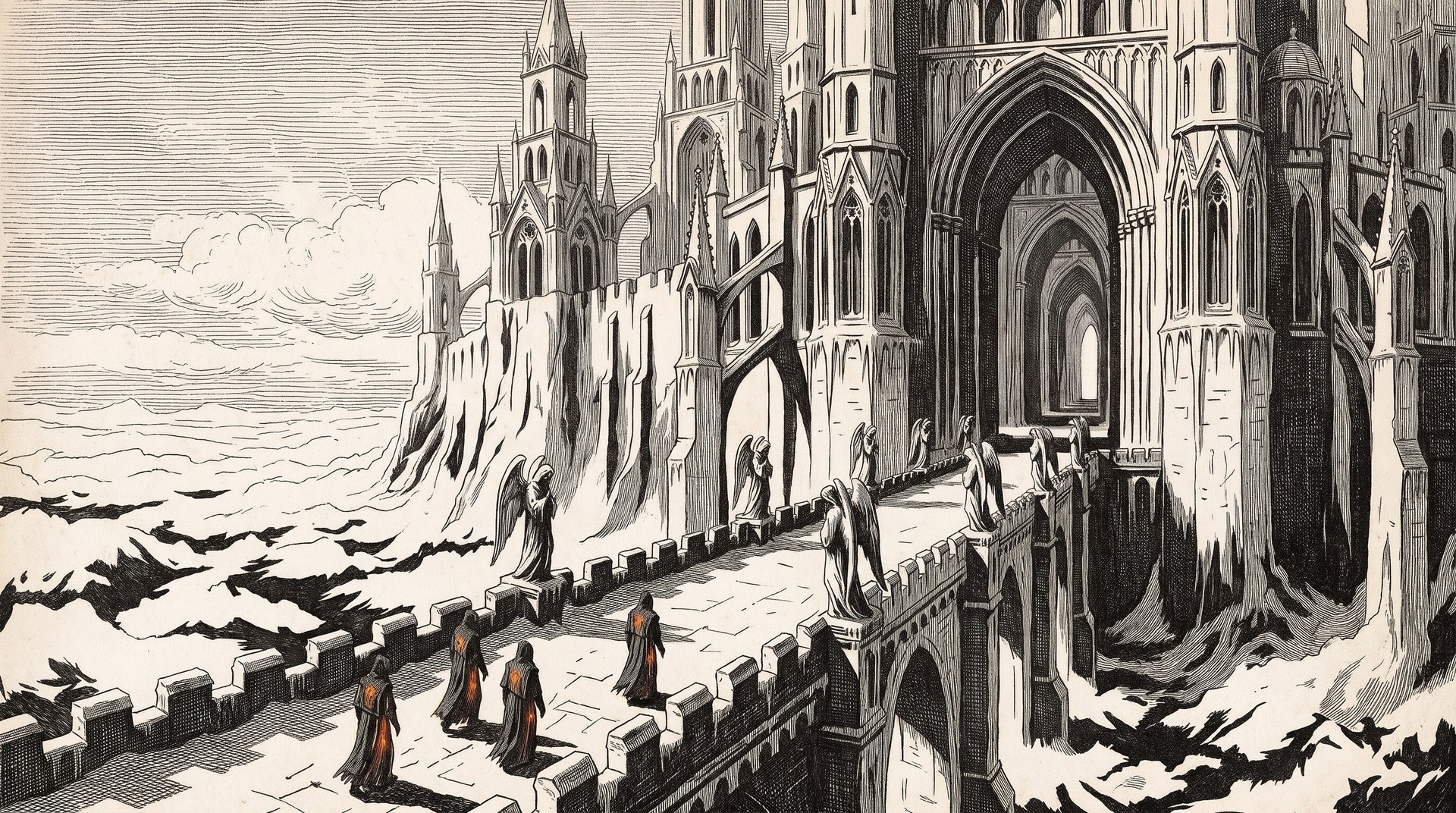
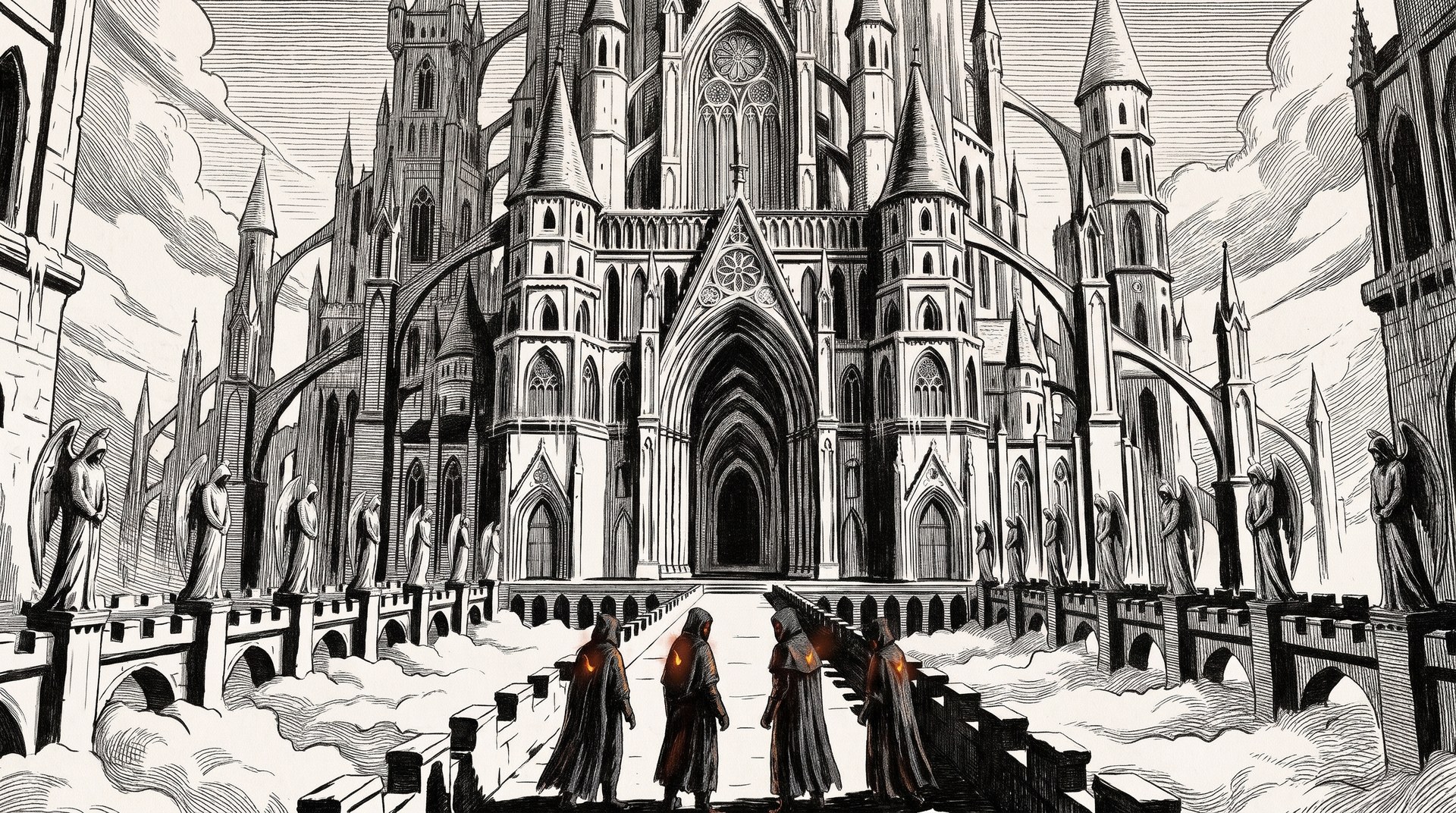
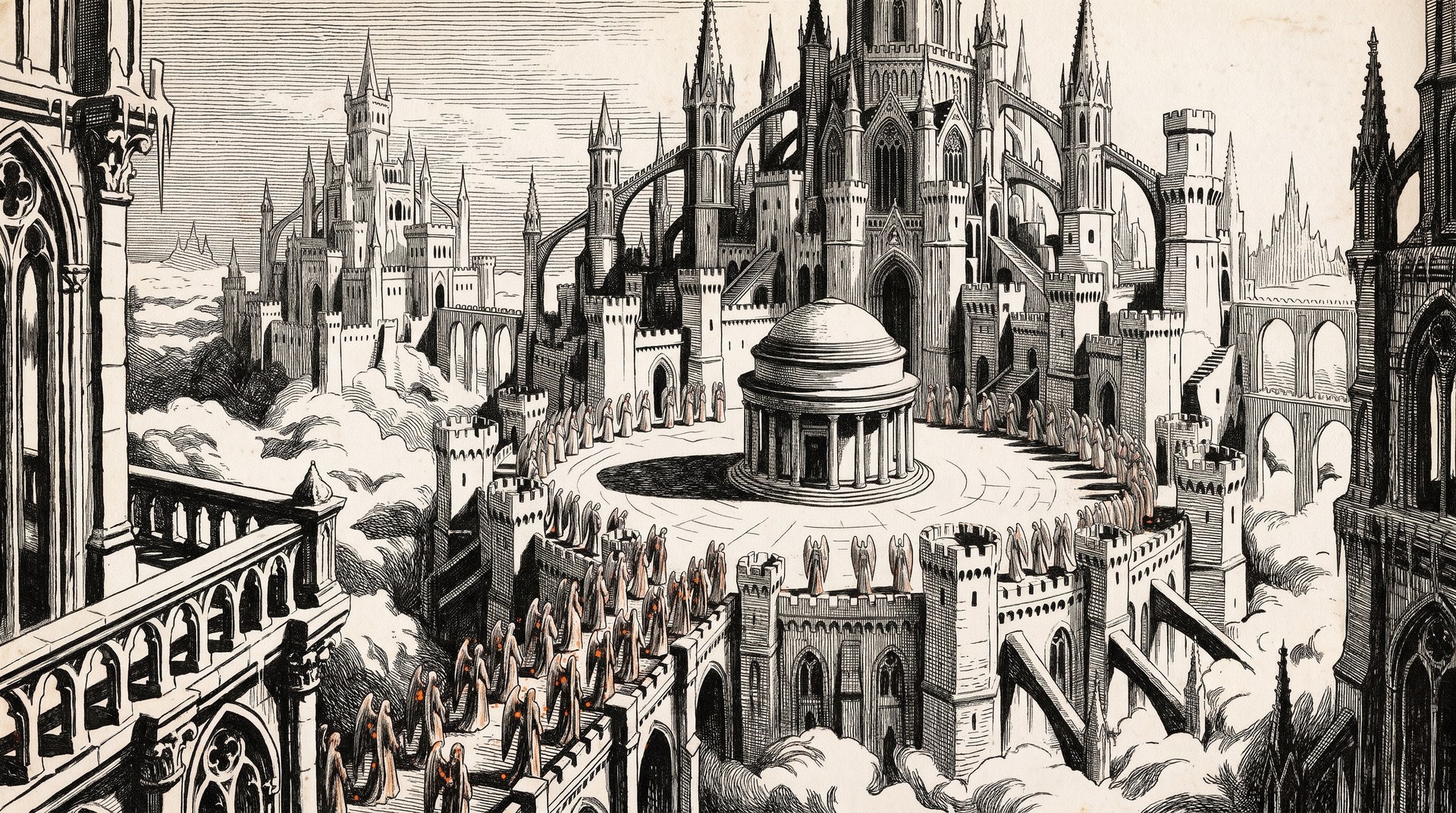
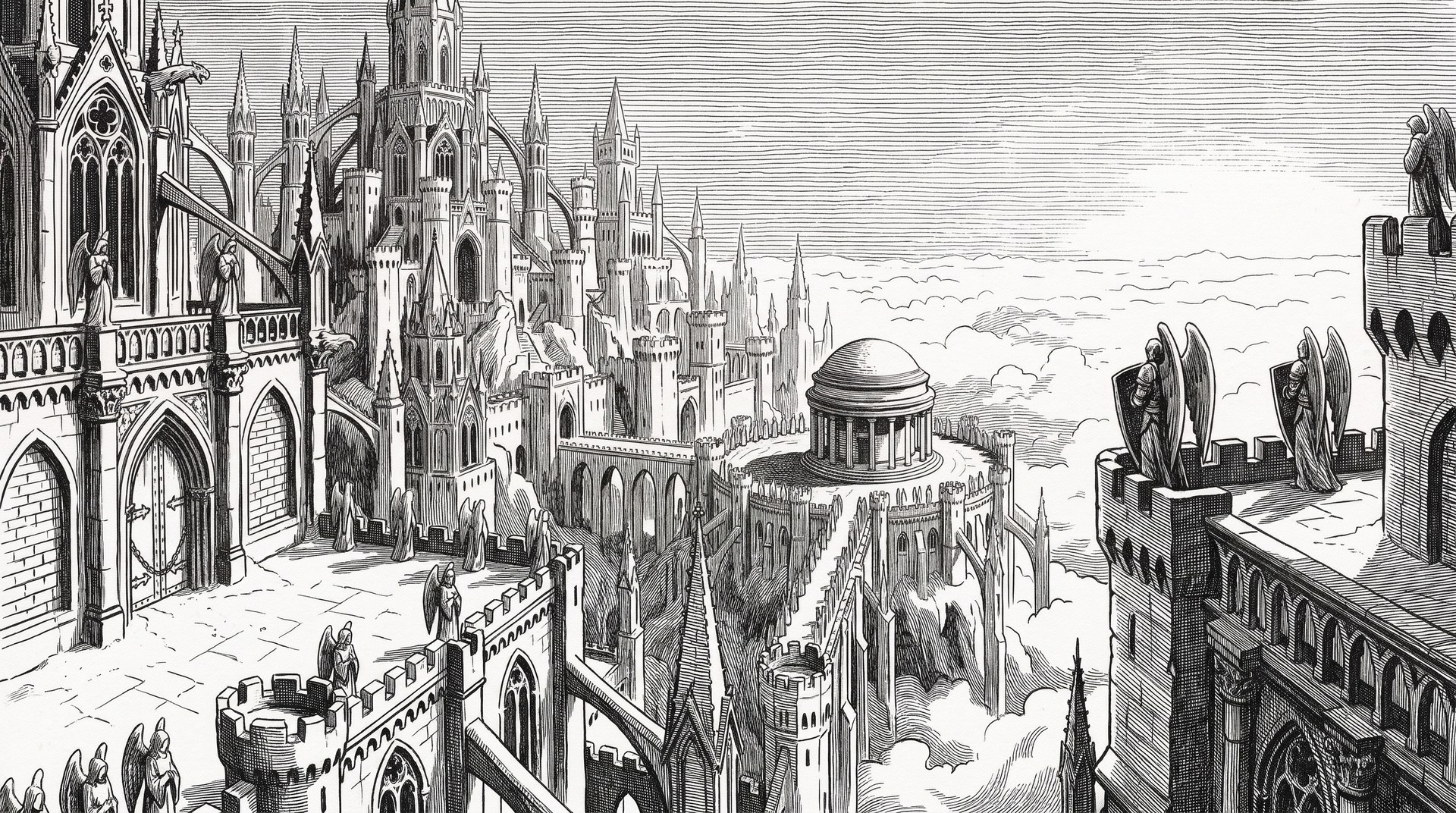
- Medieval gothic. Heaven is a castle-city of spires, flying buttresses, pointed arches nested inside pointed arches, crenellated walls and towers with conical roofs, its walls rising like cliffs over a sea of cloud. Not French classical, and not a copy of any real building: phantasmagorical, and subtly corrupted.
- The House stands at its centre: a plain round domed house like the Pantheon in Rome, always shut. It does not show the first time the party arrives; through the gate there are only arches receding into white.
- Drawn in ink. Heaven's architecture is drawn in the same inked style as the deep and the characters: black ink lines and flat black shadow shapes on white, with no hue.
 Art in progress
 Art in progress
 Art in progress
Proposal
- The wrongness is quiet. Gilding that drips like wax, angels standing perfectly still with dust on their shoulders, far too many doors and none open, stained glass that is only carved on solid stone, stairs to doors that open onto nothing, a symmetry almost perfect, and every shadow leaning toward the House. Nothing in heaven is broken; it is only wrong.
- The House is the one smooth thing. Everything else in heaven is dense gothic carving; the House is a plain drum, a low dome and a portico of plain columns. It is small, and nothing touches it: an empty court rings it, and processions stop at its edge.
- Heaven's value budget inverts the deep's. Most of a heaven frame is white and pale grey. Black is kept for ink lines, the flat shadow under arches and buttresses, and the silhouettes of the fallen, so a party reads as dark shapes on white stone, the way it reads as dark shapes on a sunlit field.
- Mist fades to white. In the deep the edges of a frame dissolve into black; in heaven they dissolve into white glare and cloud.
- The undercrofts are heaven's dark. Under the City the Apostates' cells live in vaulted undercrofts: still inked, still without colour, but low-key, lit by a shaft from a crack above.
The factions
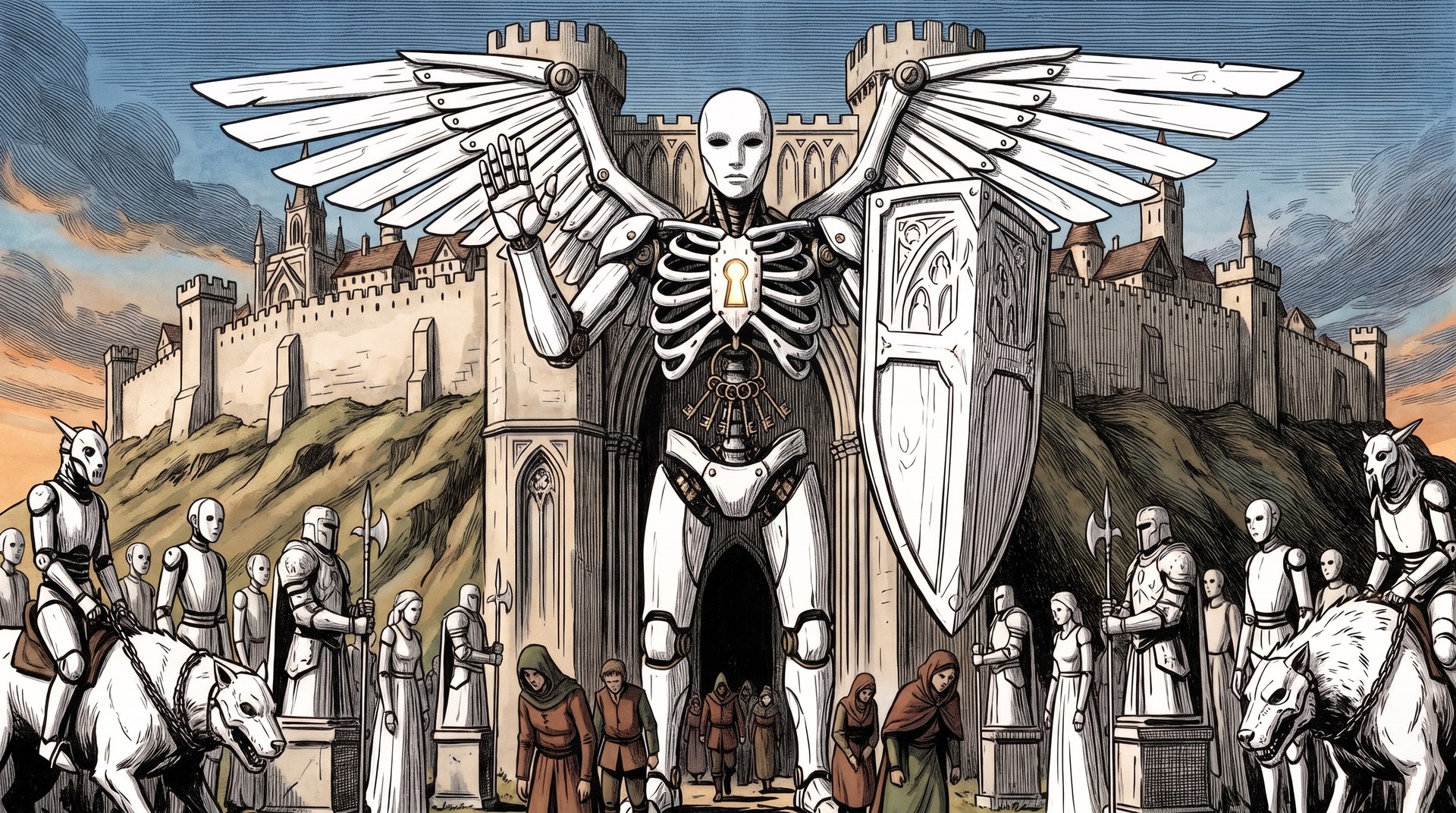
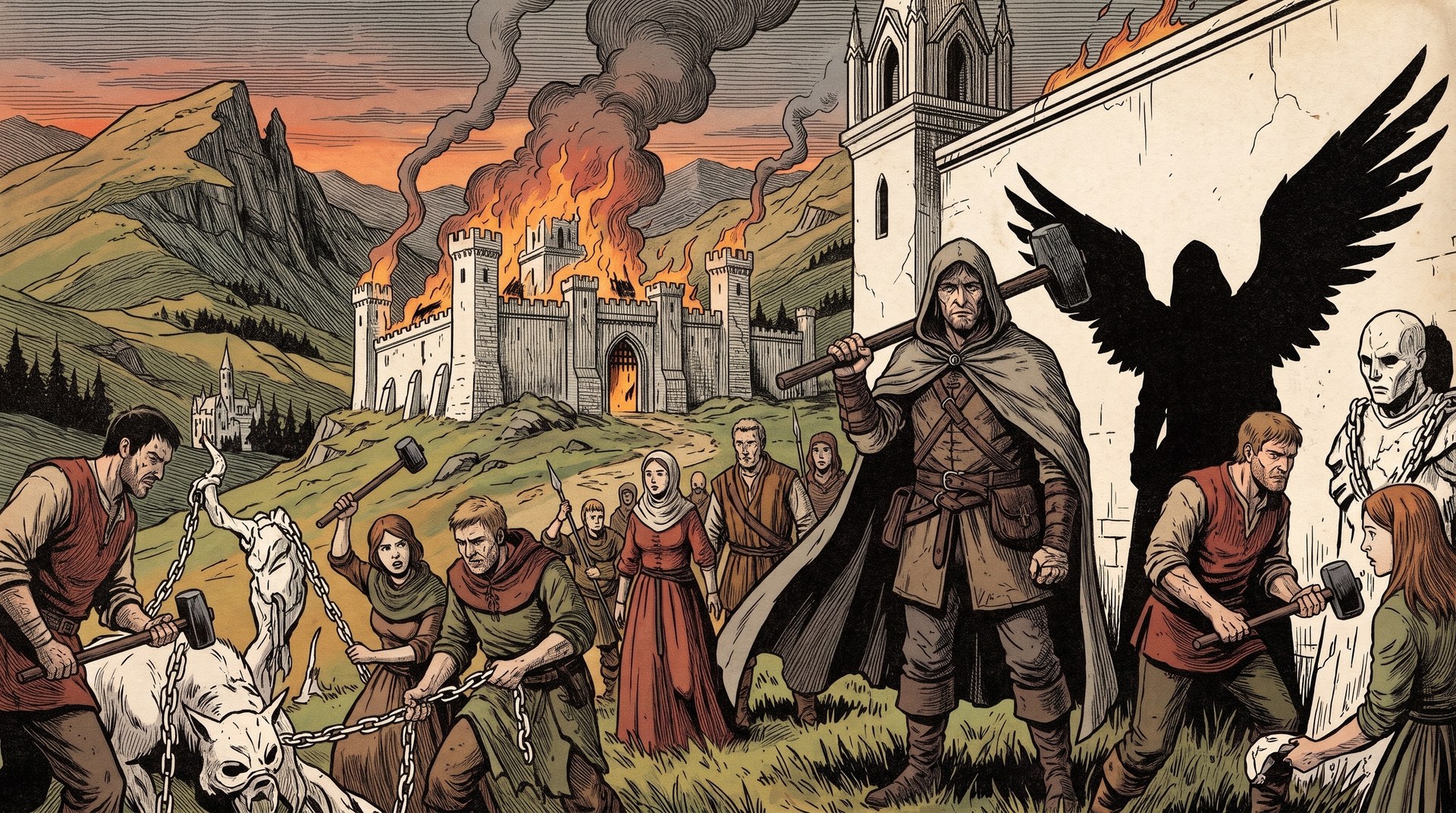
Decided by Alex on 25 October 2026: in the world, angels have no human form or borrowed body. They exist there in their true forms, which are white too, a worse white than heaven's glamour: bleached, cracked, bone and porcelain, and a radiance that blinds. The Wardens are lifeless (golems, empty armour, automata, puppets), the Heirs look godlike, and the Apostates look human. The fallen are the only clean angels.
Art in progress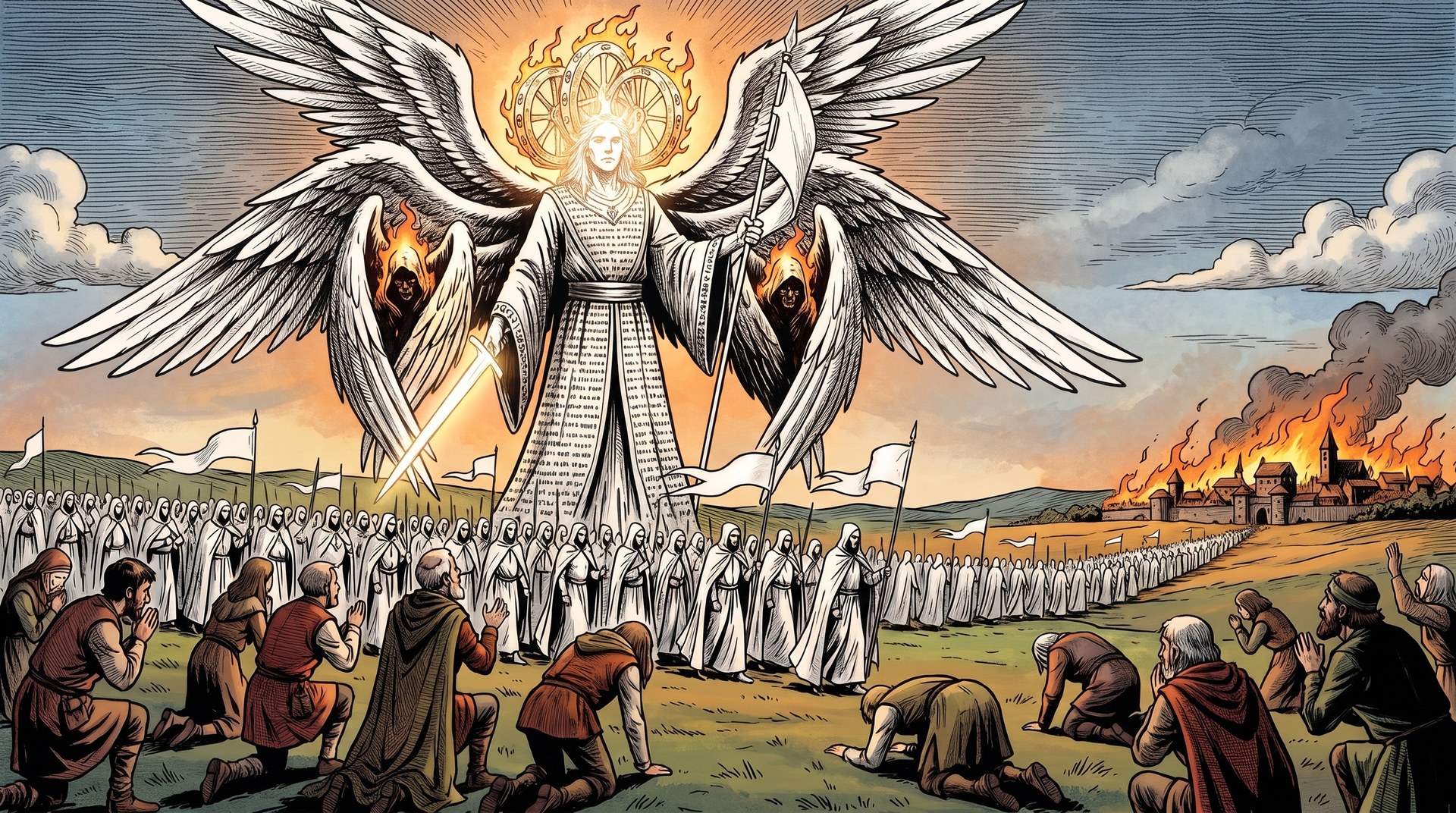 Art in progress
 Art in progress
Proposal
How each faction reads at a glance, in heaven and in the world. The silhouette carries it first, then the material, then the white.
| Wardens | Heirs | Apostates | |
|---|---|---|---|
| Silhouette | Broad and upright; wings folded tight down the back like a stone cloak; a tower shield planted | Tall and thin; wings raised high over the head; banners above the line | Smaller than other angels; wings clipped short, or only in the shadow; a hammer over the shoulder |
| In heaven | Armoured angels on the walls, all facing outward, never toward the House | Hosts in long ordered lines like processions, on siege bridges over the cloud sea | Hooded figures in the undercrofts and shut wings, at an unbarred postern at night |
| True form in the world | An automaton or puppet-saint: white porcelain and bone-white wood, brass pins, a blank mask, a keyhole in a cage of ribs, wings of stiff hinged slats | A colossal radiant figure: six wings, burning wheels for a halo, a face too bright to see, robes written edge to edge with script | An ordinary weathered person in a plain cloak; the shadow on the wall behind has great broken wings |
| Heaven's white | Porcelain, chains, padlocks, masks: white that has stopped | Radiance, robes, banners: white that burns | Almost none: the shadow, the teeth, the edge of the hammer |
| Troops | Smaller puppets, stone sentinels, beasts in white masks and chains | Zealots in white and the risen dead under white banners | Ordinary people with hammers; beasts with broken white chains |
| A region they hold | Walled, ordered and still | Pyres, processions, a town burning on the horizon | Broken ground: the world's own things loose, nobody's |
Wing pose is the silhouette key in heaven: folded for the Wardens, raised for the Heirs, clipped for the Apostates. Heaven has no colour, so this is how a host reads at a glance.
The fallen
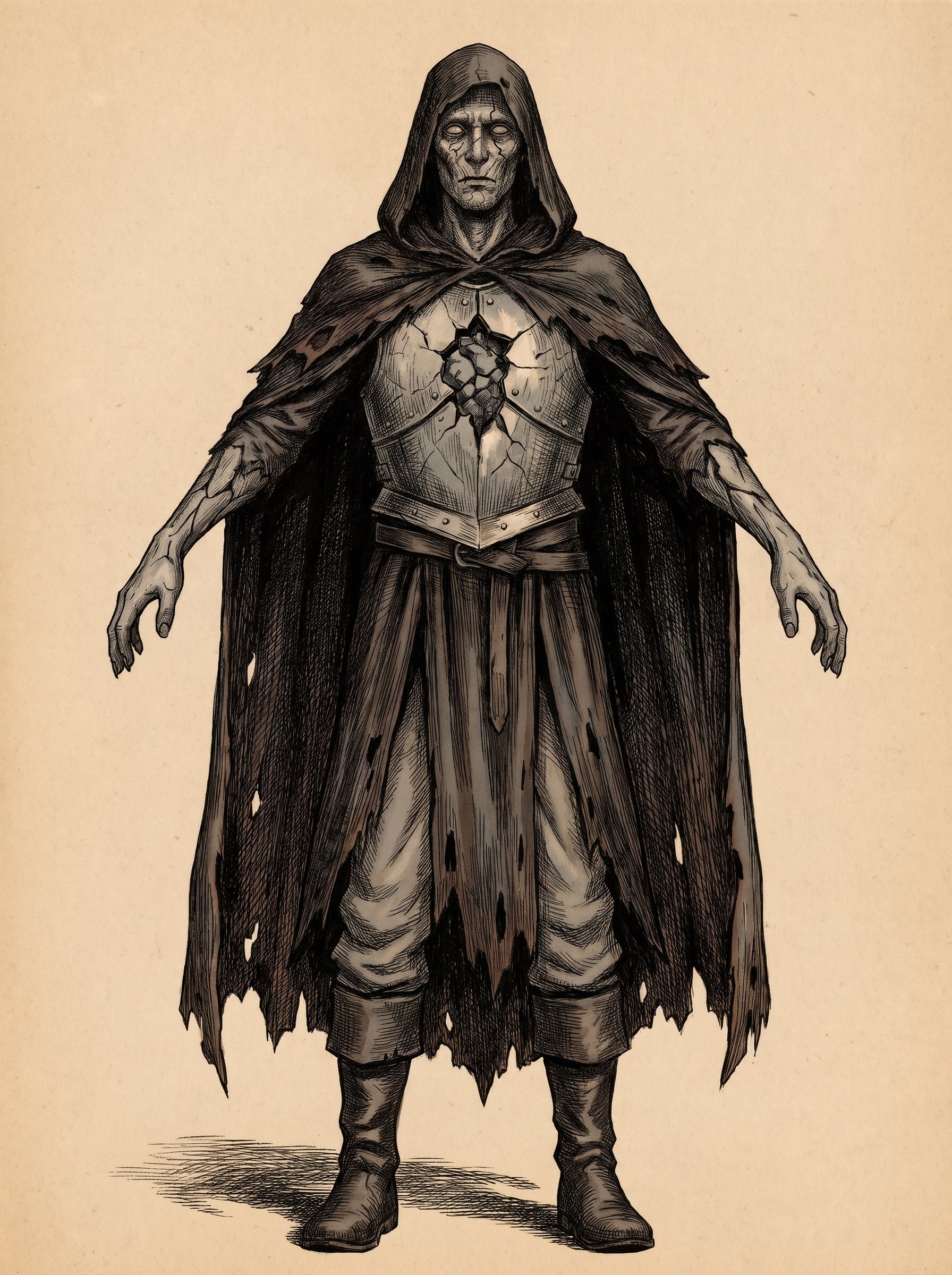
The fallen are the player characters (called the Kindled until Alex named them the Fallen on 26 October 2026). They wear layered, salvaged gear: hoods, sailcloth, riveted plates. Their ember shows through the chest, a glow behind ribs of armour or through cracks in a breastplate. It is the one consistent signature of a player character, and it reads from the isometric camera in the dark, in sunlight and on white stone.
Decided by Alex on 25 October 2026: a fallen's faction shows in its shadow, its wings and the light off it, never on its body or gear, which stay its own. On the climbs its body is clean to look at and only its light cools: the ember's light turns a little colder with every level, as the white of its kills settles in it, and the second fall burns it warm again. At its heart the coal still shows red, however cold its light has grown.
 Art in progress
 Art in progress
Four pillars
Light and colour are the story
Proposal
The climb gives light back and takes colour away. In the deep the ember is the warm pool everything happens in; beyond it the world dissolves into fog and then black. In the world between daylight returns, and with it the world's colours. In heaven the light is everywhere and means nothing: white, sourceless, with no hue, and the ember is the only colour left.
Deep frames keep about 80% of their area in the two darkest values, so the lit fifth sings. Daylight frames use the full range but keep one clear focal light and let the edges fall off. Heaven frames turn the budget over: most of the frame white and pale grey, ink and the party dark. Everywhere, a lit thing matters: loot, telegraphs, projectiles and allies glow, and against bright ground they get a rim strong enough to read.
Ember against white
Proposal
Three colour families, never mixed casually. The Ember (ember orange, gold, spark white) is the fallen: life, the player, allies, loot, crafting, fire. The Tide (tide teal, rime blue, drowned slate) is cold and forgetting: the drowned, the sea that came down from heaven, death. Heaven's white (cold chalk, bone, pale grey) is the enemy: angels, their true forms, and every piece they play.
Warm is the fallen's: in the deep it is the only light, in the world between it is the warmth of Velmarch's hearths, in heaven it is the only colour. The Tide is the cold intruder in the daylight acts. White is the enemy's colour in a coloured world: the more of it a region shows, the deeper a faction's hold.
Readable at two thousand
Monsters are designed for a three-quarter camera at about 40 pixels tall, in a crowd. Each family has its own silhouette, readable as a black shape at night and as a dark shape against bright ground by day or in heaven. Shoulders, heads and backs carry the read, not faces. Rarity is light, not geometry: a blue rim for magic, a gold glow for rares, ember for uniques. Nothing that can hurt you is dark. The details are on shape language.
Weathered and handmade
Stylised, with flat or gradient-painted colour, not photoreal textures. Detail comes mostly from light, from ink and from emissive cracks. Heroes and the monsters near you are modelled in detail; the horde in the distance is drawn with simpler models whose silhouettes still read. The geometry budgets are measured, not a style choice; shape language has the numbers.
Proposal
The materials change as you climb: soot, brass, bone, glass, obsidian and grey feathers in the deep; salt, driftwood and coral-crusted marble on the drowned coast; oak, thatch and slate, half-timber, dry-stone walls, moss and wheat in the Vale; heather, barrow stone and snow on the moors; and in heaven white stone so densely carved it reads as lace, white wax, chalk dust, porcelain and chain.
Everything in the world is old and lived-in. Hearthold is a town grown inside an upturned ship's hull: patched sailcloth, riveted iron, window boxes. Heaven is old too, but not lived-in: nothing there is repaired, only kept.
Effects
| Element | How it looks |
|---|---|
| Fire | Additive, embers rising, a white-hot core. Fire kills burst into sparks. |
| Cold | Crystalline shards with hard edges and a frost ring on the ground. The drowned collapse into water and salt. |
| Lightning | A white core with Storm-yellow edges, branching and short-lived. |
| Physical | Dust and bone chips, no glow. |
A few bright particles beat many dim ones. They read better, and they fit inside the game's particle cap.
Proposal
- The white comes off the dead. When a piece in play dies, a thin cold-white wisp rises from it and drifts into the nearest fallen's ember, which dims for a moment. It is the corruption coming back, and it shows the player why their light cools.
- In heaven, effects keep their element's colour: a Fireball in a white court is the brightest colour in the frame. White effects are kept for heaven's own: an Heir's judgement, the glare off a radiant form.
Type and frames
The faces follow one brief: an old-world inscriptional, engraved or printed face for titles; a readable serif or humanist face for reading; a narrow utility face with tabular figures for stats and numbers. Avoid the fantasy clichés, Cinzel first among them, and the generic faces of software products. This site sets its titles in IM Fell English, to sit with the engravings; the game's HUD and the wordmark keep Castoro Titling.
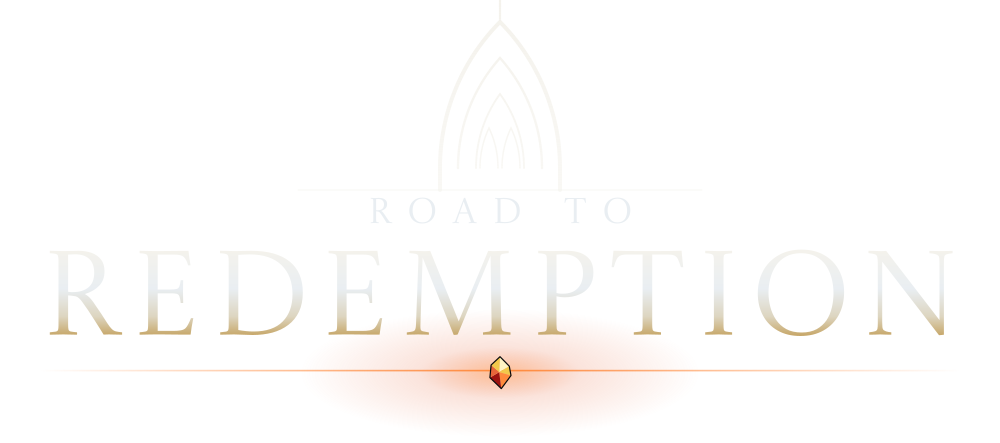
The wordmark is decided (kept by Alex on 26 October 2026): the climb in one mark. Heaven's gate is
drawn in white ink above, pointed arches inside pointed arches; the coal you wake with glows below;
and between them the name, ROAD TO REDEMPTION, in Castoro Titling, its letters white at the top and
warming toward the fire at their feet. The file is www/art/logo-wordmark.svg, generated by
design/tools/wordmark.py (edit the script, not the SVG); the old EMBERDEEP wordmark is retired.
The icon is the same gate drawn for small sizes (picked by Alex on 26 October 2026): two arches in
heavy white ink over a dark under-line, so it holds on light and dark browser tabs alike, and the
coal at its threshold. It is the site's mark in the masthead and its favicon
(www/art/logo-mark.svg, with PNGs for browsers and home screens that want one), drawn by the same
script from the same arches.
 Art in progress
 Art in progress
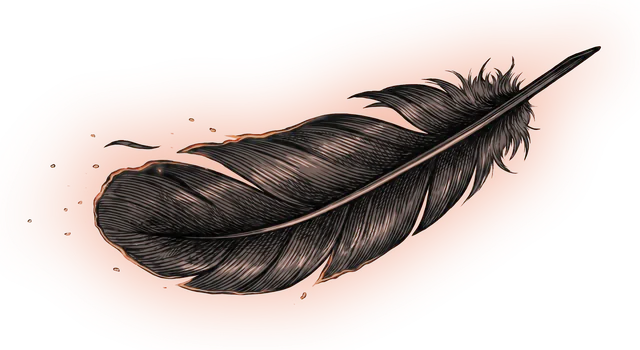
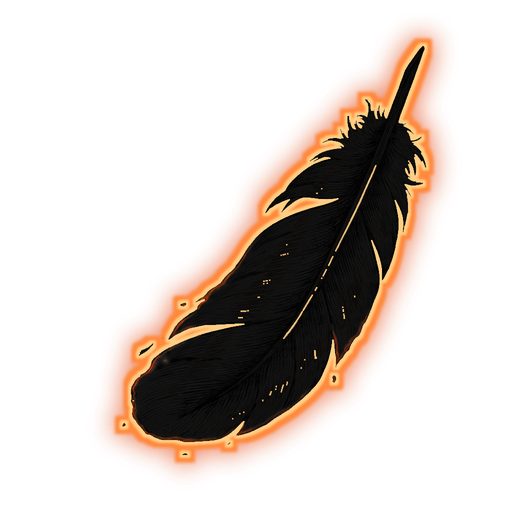
For a few hours the same day the logo was a falling feather: a fallen angel's feather, black, never
white, lying almost flat as it drifts down, its singed edge still glowing. Alex went back to the
gate and kept the feather for something else. It is painted in the house style and cut out by
design/tools/logo_art.py (www/art/feather.webp, and feather-icon.png for small sizes).
 Art in progress
 Art in progress
Proposal
Where the feather could go: the mark of the Fallen themselves (the Fallen's section of this site, a fallen's portrait frame in the game), the loading screen (a feather drifting down while the world generates), or the death screen, where your feather falls once more before you rise.
This site is the print room (chosen by Alex on 26 October 2026, from three mockups: a paper
book of plates, a dark print room, and paper leaves on a dark table). It is a dark room hung with
the game's engravings. The ground is engraved black, warm rather than the HUD's cold Soot; type is
the colour of the engravings' paper; every painting hangs in a fine plate line, a hairline frame
with a second one set off from it, and never on a mat or in a box, with its caption below in
italic like a museum label; rules and frames are the plate line's grey-brown, and ember is the one
tint, kept for links, the one button that matters and what is lit. Corners are square, there are
no rounded cards and no frosted glass. The site's own colours sit beside the palette's tokens in
www/assets/site.css (--ground, --panel, --paper, --frame).
The game's interfaces use thin Brass lines on Soot panels with square corners, as its HUD already does with its dark panels and gold. Item tooltips, in the game and on this site, follow Path of Exile's convention, a header in the rarity's colour with the modifiers below and one line of flavour at the foot. The three tooltips below are drawn from the game's own item data.
Sanguine Iron Helm of the Salamander
Armour: 36
- +(15–29) to maximum Life
- +(12–17)% to Fire Resistance
Crown of the Drowned KingIron Helm
Armour: 36
- +(40–60) to maximum Mana
- +1 to Level of all Spell Skills
- (15–25)% increased Spell Damage
- +(25–35)% to Cold Resistance
He ruled the tide until the tide ruled him.
TwinflameDriftwood Wand
Wand
Physical damage: 2–5
Critical strike chance: 7%
Attacks per second: 1.4
- (8–12)% increased Spell Damage
- Skills fire 1 additional Projectile
- (30–40)% increased Fire Damage
- (10–15)% increased Cast Speed
One flame for the living, one for the dead.
The interface and this site stay dark whatever act you are in: dark panels, fine frames, warm light kept for what matters. Dark is the world's side, and white is the enemy's. Motion is slow and ambient: embers drift, light breathes, and nothing in the interface bounces. There is one orchestrated moment per screen.
Proposal
The passive tree is drawn as the heaven you remember (decided: the white remembers heaven before you do). On a dark screen it is the one white thing in the interface: a map of heaven in white ink, its paths lit by your ember as you take them.
Key art
Proposal
- Gameplay key art (the deep): three-quarter isometric from above, the same camera as the game. A party's warm light pools in the centre, the horde presses in from the edges and dissolves into fog, and one cold light cuts across. Bright things are few.
- Establishing vistas (the world between): a high vantage point, tiny figures, a vast landscape receding in haze, one focal light, and one wrong thing on the horizon.
- Heaven: the same camera or a high vantage, white ink, the party small and dark on white stone, still angels watching, and the embers the only colour. The paintings of the bridge and the gate are the reference.
- The new key art for Road to Redemption shows the party climbing, not heading down: the old key art of a party walking toward the deep is to be redone.
Touchstones
In the deep, Path of Exile (grim readability, the language of loot), Diablo II (atmosphere, the light radius), Darkest Dungeon (ink and dread) and Mike Mignola (shadow as shape). In the drowned world, the environments of the Lord of the Rings films (scale, majesty, a lived-in old Europe) and the Romantic landscape painters: Turner, Friedrich, Bierstadt. In heaven, Gustave Doré's engravings, the white city of Falconia in Berserk, and Tsutomu Nihei's architecture too large to make sense of. For the angels, the Bible's seraphim and ophanim, puppets and automata. Throughout, Hades for glow that reads in chaos and Death's Door for stylised low-poly lit well.
Proposal
Each region has a feel to aim for, in the order of the climb. Which act each region falls in is the journey's to settle.
| Region | Feel (reference) |
|---|---|
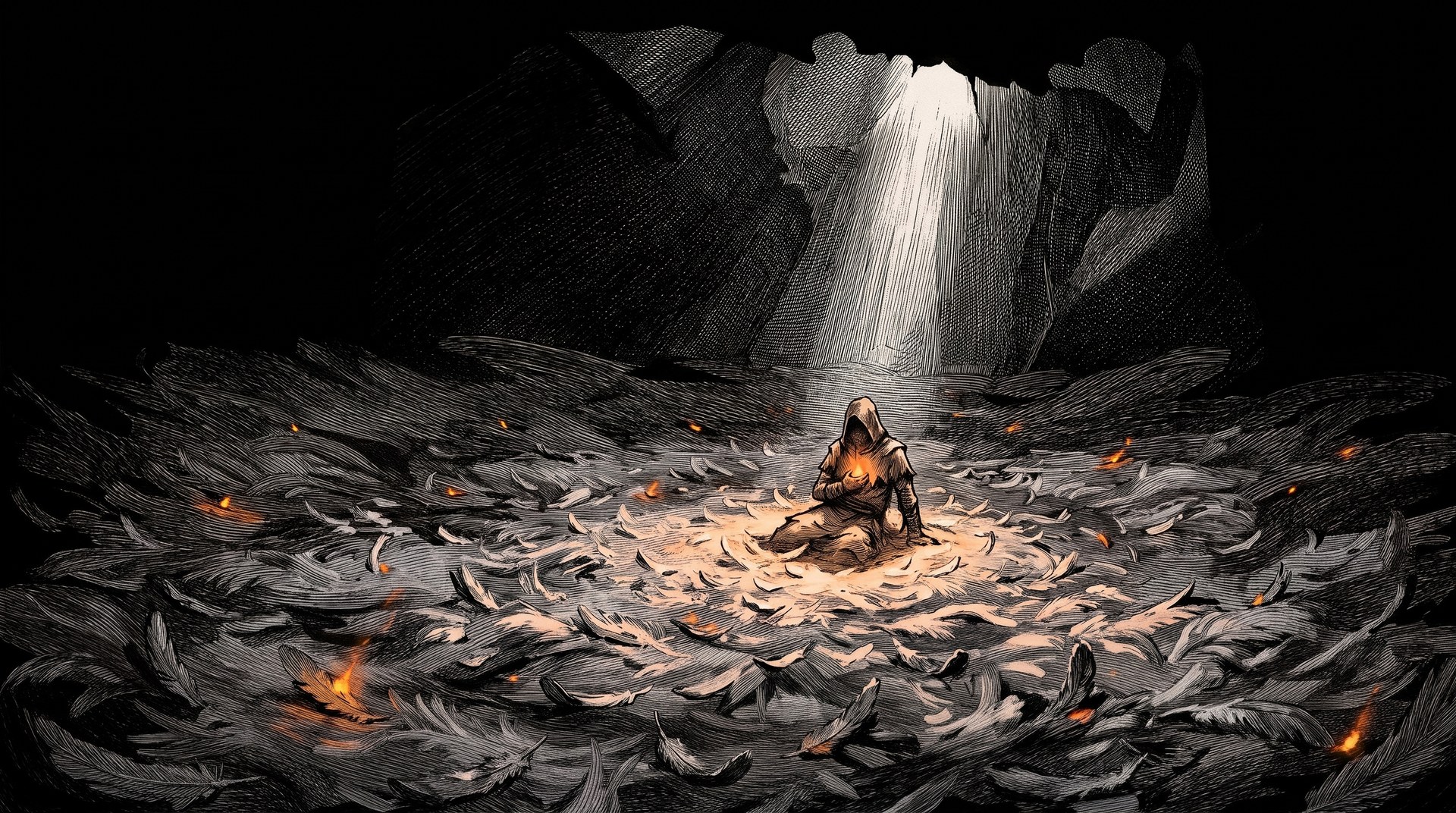
| Where you wake | A cave floor of grey feathers, cold embers, one shaft of light |
| The Underhalls and the Cinderworks | Moria |
| The Heartfire | Mount Doom, turned inward: a heap of fallen grace |
| The Drowned Coast | The Dead Marshes |
| The Drawn Sea | Nothing in the films: the first truly surreal place |
| The Vale and Hearthold | The Shire: the last warm place |
| Harrowwood and the Gloamroot | Fangorn, Mirkwood |
| The Barrow Moors and the High Pass | Rohan, the Misty Mountains, then above the clouds |
| Heaven | Doré's Paradiso, Falconia, Minas Tirith bleached to chalk |
| The Unlit | Nothing like it |
Do and don't
| Do | Don't |
|---|---|
| Give light back as you climb, and take colour away at the top | Light every act the same way |
| In the deep, let most of the frame be dark | Light the deep evenly |
| In heaven, let most of the frame be white, and draw every shape in ink | Tint heaven gold, blue or warm |
| Keep warm colour for the fallen, loot and fire | Put orange on props and walls in the deep or in heaven |
| Put heaven's white on what a faction plays | Make the world's own people or farmers white |
| Tell the factions apart by silhouette and wing pose first | Rely on colour to tell factions apart in heaven |
| Design every monster as a black silhouette first | Rely on texture detail at 40 px |
| Show rarity with light and rim colour | Give monsters unique materials |
| Weathered, repaired, salvaged in the world; kept but never repaired in heaven | Shiny, new, high-fantasy gold trim |
| One-sentence flavour with a concrete image | Explaining the lore in tooltips |